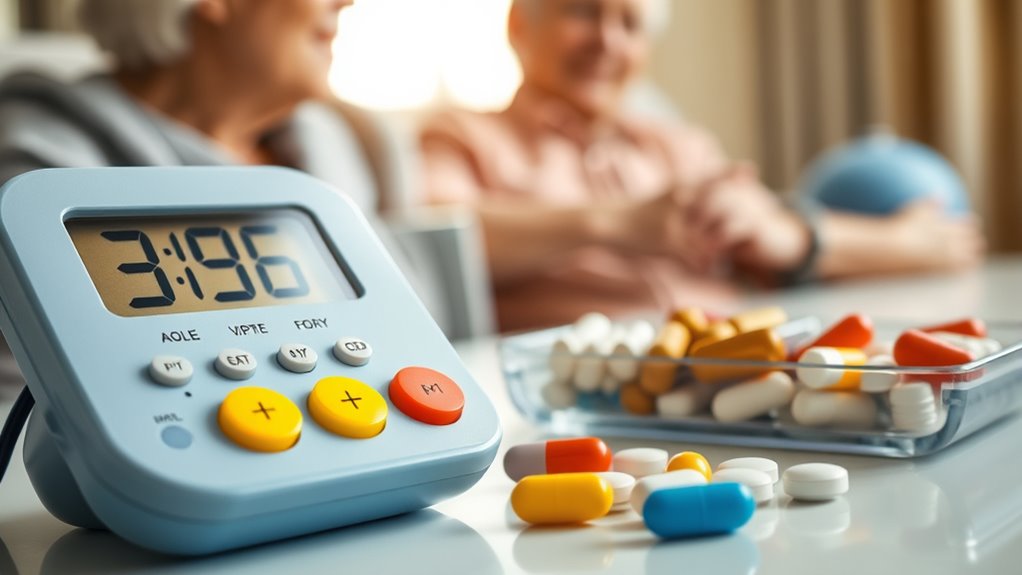

If you’re looking for the best medication reminders for dementia patients, I recommend options that combine visual alerts, audible alarms, and secure locking features. Devices like automatic dispensers with safety locks, smart pill organizers with remote monitoring, and talking alarms are all excellent choices to keep your loved ones safe and on schedule. Each offers user-friendly designs tailored for those with sensory or mobility challenges. Keep exploring to discover more solutions that can provide peace of mind.
Key Takeaways
- Devices with bright lights, loud alarms, and friendly voice prompts promote timely medication intake for dementia patients.
- Secure locking mechanisms prevent unauthorized access and double dosing, ensuring safety.
- Easy-to-use features like large compartments, simple controls, and visual cues support independence and reduce errors.
- Remote monitoring and app connectivity enable caregivers to verify adherence and manage schedules remotely.
- Long-capacity dispensers with customizable alerts reduce refill frequency and enhance consistent medication routines.
Digital Pill Organizer with Alarms and Flashing Lights
The Digital Pill Organizer with Alarms and Flashing Lights is an ideal choice for dementia patients who need reliable and easy-to-use medication reminders. This electronic dispenser uses flashing LED lights and beeping alarms to ensure doses aren’t overlooked. The dual alerts activate every 25 minutes until the pills are taken, with a repeat feature every 30 minutes to prevent missed or double doses. It has 14 large compartments, each holding up to 23 pills, perfect for daily or weekly schedules. Its user-friendly design includes easy-open tabs and removable compartments, making medication management simple and secure for seniors and caregivers alike.
Best For: seniors, caregivers, and individuals with dementia or mobility challenges who need reliable, easy-to-use medication management and reminder systems.
Pros:
- Bright flashing lights and audible alarms ensure clear visibility and audibility of reminders.
- Flexible compartments and scheduling options accommodate daily or weekly medication routines.
- Easy-open finger tabs and removable compartments simplify handling and portability.
Cons:
- The device may require regular charging or battery replacements.
- Larger pill capacity might be unnecessary for users with minimal daily medication needs.
- The multiple alarm features could be overwhelming or confusing for some users.
Automatic Pill Dispenser with Safety Lock
Automatic pill dispensers with safety locks are ideal for caregivers and seniors who need reliable medication management without constant supervision. They let you program doses for up to 28 days, with audio and visual alerts that prevent missed or double doses. Their high-capacity design holds up to 672 pills, reducing refill frequency, while interchangeable rings allow customization for individual needs. Safety features like locking covers prevent unauthorized access, and alerts keep users on schedule. The easy-to-read display and transparent lid make medication checks simple. Portable and battery-operated, these dispensers support safe, independent living while providing peace of mind for caregivers.
Best For: caregivers, seniors, and individuals managing multiple medications who need a reliable, safe, and easy-to-use pill dispensing solution without ongoing subscription costs.
Pros:
- Program up to 28 days of medication with audio and visual alerts to prevent missed or double doses
- High-capacity design stores up to 672 pills, reducing refill frequency
- Safety features like locking cover and magnifier enhance security and usability
Cons:
- Requires batteries, which may need frequent replacing depending on usage
- Limited to aspirin-sized pills; larger or different pill sizes may not fit properly
- Setup and programming may be complex for users unfamiliar with digital devices
Adamson TimelyMed Smart Pill Dispenser with Alarm
For caregivers seeking reliable medication management, the Adamson TimelyMed Smart Pill Dispenser with Alarm stands out by providing clear audio and visual alerts that help dementia patients remember their doses. The device sends timely reminders, ensuring medications are taken on schedule. With the free app, caregivers can monitor adherence remotely, verify if the dispenser lid has been opened, and check medication intake in real time. Its security features include a lock with two keys, preventing unauthorized access. Easy to set up and customize, the dispenser supports multiple users and offers dependable WiFi connectivity, making medication management simple, safe, and effective for both patients and caregivers.
Best For: caregivers and family members managing medication schedules for dementia patients or seniors needing reliable dose reminders and remote supervision.
Pros:
- Provides clear audio and visual alerts to prevent missed doses.
- Enables remote monitoring of medication adherence via a user-friendly app.
- Features a secure lock with two keys to restrict access and enhance safety.
Cons:
- Setup may require familiarity with smartphone apps for optimal use.
- Limited to 28 days of medication management with nine included dosage rings.
- Dependence on WiFi connectivity; may face issues in areas with unstable internet.
MEDCENTER Talking Alarm Clock for Seniors and Visually Impaired
MedCenter Talking Alarm Clock stands out as an ideal solution for seniors, visually impaired, hearing impaired, and dementia patients who need reliable medication reminders. With up to four alarms daily, it offers loud and extra loud options, ensuring users hear the alerts. The friendly female voice announces the time, date, and medication instructions clearly, supporting medication adherence. Its large, backlit display is easy to read at night, while simple controls make setup straightforward without needing a smartphone. Users can confirm medication intake and receive reminders for upcoming doses, helping maintain independence and safety. This clock is a practical, user-friendly device that caregivers can rely on to monitor medication schedules effectively.
Best For: seniors, visually impaired, hearing impaired, and dementia patients who need reliable medication reminders and easy-to-use alert systems.
Pros:
- Loud and extra loud alarm options ensure users hear alerts clearly.
- Friendly female voice provides clear time, date, and medication reminders.
- Large backlit display allows easy viewing at night and in low light conditions.
Cons:
- Requires manual setup, which may be challenging for some users with severe cognitive impairment.
- No smartphone or app integration limits remote monitoring capabilities.
- Limited to four alarms per day, which may not suit individuals with more complex schedules.
EziMedPil Automatic Pill Dispenser with Alarm
The EziMedPil Pill Dispenser is an excellent choice for caregivers and seniors who need reliable medication management. It allows us to program up to 28 days of doses with clear audio and visual alerts, ensuring correct timing and reducing missed or double doses. Its locking cover and safety features prevent unauthorized access, while the mini magnifying glass helps with precise dosage viewing. Designed for ease, it features a simple setup, a bright LCD display, and intuitive controls. With a large capacity of 672 pills and customizable templates, it’s perfect for daily use at home or on the go, promoting safety, independence, and peace of mind.
Best For: seniors, caregivers, and individuals with chronic conditions who require reliable, secure, and easy-to-use medication management at home or while traveling.
Pros:
- Program up to 28 days of medication doses with audio and visual alerts for improved adherence.
- Locking cover and safety features prevent unauthorized access, ensuring medication safety.
- Large capacity of 672 pills and customizable templates reduce refill frequency and support personalized schedules.
Cons:
- May be more expensive than basic pill dispensers due to advanced features.
- Requires batteries, which need replacement to ensure continuous operation.
- Slightly larger size could be less convenient for very tight travel or storage spaces.
Live Fine 28-Day Automatic Pill Dispenser with LCD Display
When managing medications for dementia patients, guaranteeing timely doses is critical, and the Live Fine 28-Day Automatic Pill Dispenser with LCD Display excels at this. It organizes, monitors, and dispenses pills, vitamins, and supplements for up to four weeks with 28 high-capacity slots, reducing refill needs. The transparent lid allows easy visual checks, while the adjustable reminder system features audio and visual alerts, set up to nine times daily. Its large LCD display shows the current time, upcoming alarms, and battery status, making it simple to operate. The secure lockable cover, user-friendly design, and portability ensure safety and convenience for patients, caregivers, and visiting nurses alike.
Best For: caregivers, family members, and healthcare providers managing medication routines for dementia patients or individuals requiring reliable, easy-to-use pill management.
Pros:
- Organizes medications for up to 4 weeks with 28 high-capacity slots, reducing refill frequency.
- Features an easy-to-read large LCD display with customizable alarms for precise medication timing.
- Secure lockable cover ensures safety and prevents unauthorized access.
Cons:
- May be too bulky for travel or portable use in small bags.
- Requires batteries, which need replacement over time.
- Limited to managing pills, vitamins, and supplements, not liquid medications.
Pill Reminder with 8 Alarms per Day, Pill Tracker, Timer, Medication Reminder Device
This pill reminder is an excellent choice for caregivers and individuals managing complex medication schedules, especially for dementia patients who need reliable reminders. It features eight separate alarms daily, ensuring medications are taken on time, with alarms that continue until the battery is replaced. Its compact size makes it easy to carry everywhere, and setup is quick with just three buttons and clear instructions. The LCD display, countdown timer, and pill tracker help users stay organized. Powered by a single AAA battery, it offers hassle-free operation. Overall, this device combines simplicity and reliability to keep dementia patients safe and on schedule.
Best For: individuals and caregivers managing complex medication routines, especially elderly, Parkinson’s patients, or dementia patients requiring reliable, on-time reminders.
Pros:
- Eight independent alarms ensure consistent medication adherence throughout the day.
- Compact, pocket-sized design makes it easy to carry and use on-the-go.
- Simple three-button setup with clear instructions allows quick customization without hassle.
Cons:
- Only one AAA battery may require replacement more frequently with heavy use.
- Limited to basic features; lacks advanced connectivity or app integration.
- Alarms continue until battery replacement, which could be inconvenient for some users.
Daviky Automatic Pill Dispenser with Alarm and Lock
For caregivers and elderly individuals managing complex medication schedules, the Daviky Automatic Pill Dispenser with Alarm and Lock offers a reliable solution. It features programmable doses for up to 28 days, with audio and visual reminders to guarantee timely medication intake. Its six interchangeable rings allow customization, reducing missed or double doses. The dispenser’s large-capacity compartments cut down refill frequency, while the bright LCD display and simple controls make operation easy. The locking cover prevents unauthorized access, providing safety and security. Compact and portable, it’s designed to support independence while assuring medications are taken correctly and securely.
Best For: caregivers and elderly individuals managing complex medication schedules who need a secure, easy-to-use, and customizable pill dispensing solution.
Pros:
- Ensures accurate medication adherence with programmable doses and reminders.
- Offers high-capacity compartments, reducing refill frequency and increasing convenience.
- Features a locking cover for added security against unauthorized access.
Cons:
- May be bulky for travel or portability in some settings.
- Requires initial setup and programming, which could be challenging for very tech-averse users.
- Limited to 28 days of medication management; not suitable for longer-term or multi-month schedules without reprogramming.
Medication Pill Reminder with Custom Voice Alarms
The Bovintex Medication Pill Reminder stands out as an ideal choice for seniors and individuals with dementia who need personalized, easy-to-use medication alerts. This rechargeable device features three custom voice alarms, allowing us to record reminders in our own voices, making prompts more familiar and comforting. Its simple interface, adjustable volume, and auto-dimming high-contrast display make it accessible for those with hearing or vision challenges. Compact and USB-powered, it requires no batteries and can last up to six months on a full charge. Its tailored alarms help ensure medication adherence, providing peace of mind for caregivers and safety for loved ones.
Best For: seniors, elderly individuals, and caregivers seeking a simple, personalized medication reminder device that enhances adherence and provides familiar prompts.
Pros:
- Custom voice recording feature makes reminders more personal and comforting
- Easy-to-use interface with adjustable volume and auto-dimming high-contrast display suitable for users with hearing or vision impairments
- Rechargeable via USB with long battery life, eliminating the need for battery replacements
Cons:
- Limited to three alarms, which may not suit users with complex medication schedules
- Tabletop design may not be as portable as wearable or compact reminder options
- Does not include additional features like smartphone connectivity or multi-user profiles
Digital Pill Box with Alarms and Beeping Reminders
Digital Pill Box with Alarms and Beeping Reminders is an ideal choice for caregivers and seniors managing complex medication schedules, especially those with memory challenges. Its triple alarms—flashing lights, loud escalating beeps, and visual indicators—ensure timely doses and repeat every 30 minutes until taken, reducing missed or double doses. The device features a large, monthly pill organizer with oversized compartments, making it easy to handle larger pills and organize medications for up to 14 days. Designed with seniors in mind, it has easy-open compartments, clear labels, and foolproof alerts, helping seniors stay safe and adhere to their medication routines effortlessly.
Best For: seniors, caregivers, and individuals with memory challenges managing complex medication schedules and requiring reliable reminders.
Pros:
- Triple alarm system with flashing lights, loud beeps, and visual indicators ensures no missed doses
- Large monthly pill organizer with oversized compartments simplifies handling larger pills and organizing for up to 14 days
- User-friendly design with easy-open compartments and clear labels minimizes errors and enhances safety
Cons:
- May be bulky for travel or portable use due to large compartments and alarms
- Requires regular charging or battery replacement to maintain alarm functionality
- Limited customization options for different dosing schedules beyond twice daily
KLIM Smart Pill Dispenser with Alarm
Caregivers seeking a reliable way to guarantee medication adherence for dementia patients will find the KLIM Smart Pill Dispenser with Alarm particularly effective. It uses audio and visual alerts to remind patients to take their meds on time, while a free app allows us to monitor schedules remotely. With support for up to 28 days and nine customizable dosage rings, it fits various routines. The dispenser features remote supervision via WiFi, progress tracking, and security locks to prevent accidental access. Easy to set up and operate, it assures continuous, dependable medication management, giving us peace of mind and keeping our loved ones safe and secure.
Best For: caregivers and family members managing medication routines for elderly, dementia, or Alzheimer’s patients who need reliable, remote medication supervision.
Pros:
- Supports up to 28 days with customizable dosage rings for flexible scheduling
- Provides remote monitoring and supervision via WiFi, enhancing safety and oversight
- Features secure lock mechanism with keys, safeguarding medication access
Cons:
- Requires a WiFi connection, which may be limited in some areas
- May be more expensive than basic pill dispensers due to advanced features
- Setup and operation might be complex for users unfamiliar with smart devices
Colorwing® 2025 Smart Pill Dispenser for Seniors
For seniors and dementia patients who need a reliable, easy-to-use medication management solution, the Colorwing® 2025 Smart Pill Dispenser stands out with its arthritis-friendly one-touch access and smart dual-lock protection. Its patented press-release technology requires no lifting, making it accessible for those with limited dexterity. The dual-lock system combines fingerprint scanning to prevent impulsive access with a backup key to reduce forgotten schedules, enhancing safety. With customizable weekly or monthly plans, 7 reversible dose rings, and daily timed dispensing, it simplifies complex routines. Wireless Bluetooth sync and a long-lasting rechargeable battery further ensure convenient, secure medication management for seniors and their families.
Best For: seniors and dementia patients seeking a reliable, easy-to-use medication management solution with enhanced safety and adherence features.
Pros:
- Arthritis-friendly one-touch access with patented press-release technology requiring no lifting
- Smart dual-lock protection combining fingerprint scanning and backup key to prevent accidental overdoses
- Customizable weekly or monthly medication plans with daily timed dispensing and intuitive design
Cons:
- May require initial setup time despite multilingual guides and manuals
- Bluetooth connectivity relies on a compatible smartphone and app for full feature access
- Larger size of the organizer may be less discreet for small living spaces
Automatic Pill Dispenser with Alarm and Light
An automatic pill dispenser with alarm and light is an ideal choice for seniors and individuals with dementia who need consistent medication management. It manages four-week schedules, organizes pills, and dispenses vitamins or supplements accurately. The device offers customizable audio-visual reminders—up to six times daily—to ensure timely intake, reducing caregiver stress. Its intuitive LCD display and detachable carousel make setup simple, while safety features like locking covers and overdose prevention safeguards keep medication secure. Designed for ease of use, the transparent lid allows quick visual checks, and the device’s clear alerts help users stay on track, promoting independence and peace of mind.
Best For: seniors, individuals with dementia, or anyone requiring reliable, independent medication management with added safety features.
Pros:
- Simplifies medication adherence through customizable audio-visual reminders and easy setup.
- Enhances safety with locking covers, overdose prevention, and secure storage for multiple medications.
- Supports long-term use with four-week scheduling, high-capacity storage, and easy refilling.
Cons:
- May be more expensive than basic pill organizers due to advanced features.
- Requires some initial setup and familiarization with its electronic interface.
- Bulkier design might be less convenient for portable use or small spaces.
Windtrace Automatic Pill Dispenser for Elderly
The Windtrace Automatic Pill Dispenser is an excellent choice for seniors who need reliable medication reminders, especially those with memory challenges or cognitive impairments. It features a 28-day capacity with customizable dosing schedules, ensuring users take the right medications at the right times. The device uses loud alarms and flashing blue lights to alert users visually and audibly, reducing missed doses. Its easy-to-read LCD screen displays clear information, and the removable tray with six dosage rings offers flexible scheduling options. Designed for accessibility, it’s simple to refill and operate, making medication management safer and more convenient for seniors and caregivers alike.
Best For: seniors and caregivers seeking a reliable, easy-to-use medication dispenser with customizable dosing schedules and strong visual and auditory alerts.
Pros:
- Features loud alarms and flashing lights to ensure medication adherence
- Easy-to-read LCD display and simple refilling process enhance accessibility
- Removable tray with six dosage rings offers flexible scheduling options
Cons:
- Requires four AA batteries, which need regular replacement
- Limited to 28-day capacity, not suitable for long-term medication management without refills
- May be less effective for users with severe visual or hearing impairments without additional assistance
FEATY Pill Reminder for Meds Bottles
FEATY Pill Reminder for Meds Bottles stands out as an ideal choice for caregivers and individuals with dementia who need a simple, visual way to monitor medication adherence. Its intuitive design uses a push slider with clear red and green indicators, making it easy to see if pills have been taken. Made from food-grade ABS, it’s safe and reusable, reducing waste and costs. The adjustable elastic rope fits various bottle sizes, and its compact size makes it portable for outings. With customer support and a 30-day guarantee, this affordable reminder helps keep medication routines consistent and straightforward, promoting safety and peace of mind.
Best For: caregivers and individuals with dementia seeking a simple, visual, and portable medication reminder solution.
Pros:
- Easy-to-use push slider with clear red and green indicators for quick medication status check
- Made from food-grade, reusable ABS material that is eco-friendly and durable
- Adjustable elastic rope fits various bottle sizes and is portable for on-the-go use
Cons:
- May not accommodate extremely large or unusually shaped bottles comfortably
- Limited to visual cues, lacking electronic or alarm features for missed doses
- Small size might be less suitable for users with visual impairments or dexterity issues
Factors to Consider When Choosing Medication Reminders for Dementia Patients (Locking)
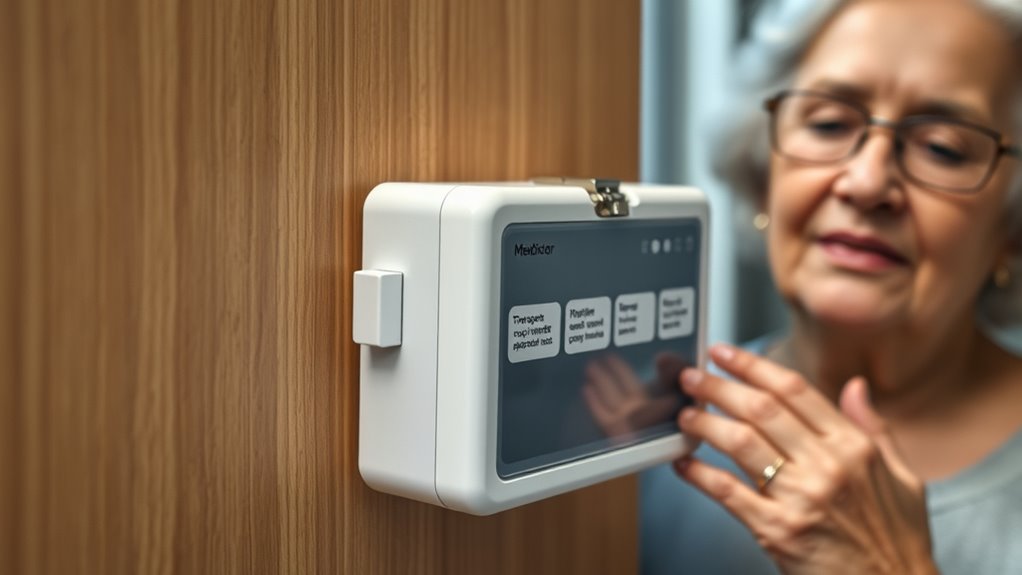
When choosing a locking medication reminder, I consider how secure and user-friendly it is, since safety is a top priority. I also look at the types of locks available, along with visual and audio cues that help patients recognize their medication times. Finally, I evaluate whether the device’s capacity matches the patient’s medication needs to guarantee consistency and ease of use.
Security Features Importance
Choosing a medication reminder with robust locking features is essential because it safeguards against unauthorized access and accidental ingestion. Secure locks, like fingerprint scanners or physical keys, ensure only trusted caregivers or family members can dispense medications, reducing overdose risks. Locking mechanisms also help establish controlled routines, decreasing chances of missed doses or taking incorrect medications. Many devices include tamper-proof designs that discourage patients from opening dispensers without permission. These features not only protect the patient but also offer peace of mind for caregivers, knowing medications are secure from misuse. Prioritizing strong locking features creates a safer environment, minimizing accidental or intentional mishandling of medication, and ultimately helps maintain the patient’s health and safety more effectively.
Ease of Use Design
Selecting a medication reminder with user-friendly features is essential for ensuring effective medication management for dementia patients. Devices with simple controls, like large buttons or touchscreens, make it easier for users with limited dexterity or cognitive challenges to operate them confidently. Clear, high-contrast displays with large fonts improve readability, especially for those with visual impairments. Audible and visual alerts should be intuitive and straightforward, helping reduce confusion during medication times. Minimal setup steps and straightforward operation are key, allowing caregivers and patients to manage routines without frustration. Features like one-touch access or automatic dosing further simplify adherence and lower the risk of errors. Overall, an easy-to-use design promotes independence and reliable medication management for dementia patients.
Locking Mechanism Types
Locking mechanisms play a crucial role in ensuring medication safety for dementia patients by preventing unauthorized access. There are several types to evaluate. Keypad locks and combination locks allow customization, restricting medication access to trusted individuals. Electronic locks with PIN or code entry can be set up for caregivers or family members, providing control and flexibility. Biometric options like fingerprint scanners offer a secure, hygienic way to restrict access based on individual identification, reducing the risk of misuse. When choosing a locking mechanism, it’s important to balance security with ease of use—taking into account the patient’s ability to operate the lock comfortably. Durability is also key, ensuring the lock withstands daily use. The right choice helps protect medication while maintaining safety and peace of mind.
Visual and Audio Cues
When considering medication reminders for dementia patients, visual and audio cues play a vital role in guaranteeing they take their medications correctly. Visual cues like flashing lights and large, color-coded compartments help patients easily identify when to take their meds, reducing confusion and mistakes. Audio alerts, such as loud beeping or spoken reminders, guarantee patients hear prompts even if their vision is compromised. Combining these cues addresses common sensory deficits, increasing adherence. It’s important that alerts are timely and last long enough to capture attention without causing distress or overload. Clear, simple signals are essential to safety, helping prevent missed doses or double dosing. By choosing reminders with effective visual and audio cues, we can better support dementia patients’ medication routines and overall well-being.
Medication Capacity Needs
Considering the medication capacity of a reminder device is essential to guarantee it meets the needs of dementia patients. I always assess how many medications and doses are required daily to ensure the device can handle current and future prescriptions. Choosing a reminder with sufficient capacity prevents overcrowding and makes access easier, especially if it features large compartments or multiple dosage rings. I also look for devices that support long-term storage, like 14 or 28 days, to reduce refill frequency. Ensuring the capacity matches the patient’s medication routine minimizes missed doses and promotes safety. By carefully evaluating these factors, I can select a reminder that provides reliable support and adapts to potential medication changes, giving both caregivers and patients peace of mind.
User Accessibility Factors
Ensuring medication reminders are accessible is crucial for supporting dementia patients’ independence and safety. I look for devices with large, clear displays and easy-to-press buttons, which help those with visual or motor impairments. Compartments that open with minimal force make it easier for individuals with dexterity challenges to access their pills without frustration. Audible alerts should have adjustable volume levels and friendly voice prompts so users with hearing impairments understand when to take medication. Visual cues like flashing lights and color coding help those with hearing issues or cognitive decline recognize medication times. Simple, intuitive controls or minimal setup steps are essential to reduce confusion and foster independence. Accessibility features are key to ensuring consistent medication management and peace of mind.
Compatibility With Caregivers
Choosing medication reminders with caregiver compatibility features can substantially enhance safety and oversight. Devices that integrate with caregiver apps allow me to monitor adherence remotely and receive timely alerts if a dose is missed or access is attempted. Compatibility with remote lock and disengage functions gives me control over medication access, preventing accidental or intentional misuse. Multiple user profiles enable personalized settings for each patient, making it easier to track individual compliance. Real-time notifications keep me informed instantly about any issues, so I can intervene promptly. Additionally, compatibility with communication tools allows me to coordinate support, send reminders, or trigger emergency responses when needed. Overall, these features provide peace of mind by ensuring I can oversee medication management effectively while maintaining my loved one’s safety.
Frequently Asked Questions
How Do Medication Reminders Adapt to Changing Medication Schedules?
Medication reminders adapt to changing schedules by allowing easy updates through apps or devices. I check in regularly to adjust the timing, dosage, or frequency as prescribed. Many systems offer automatic alerts for new schedules, ensuring my loved one stays on track without confusion. This flexibility helps me feel confident that their medication routine remains safe and personalized, even as their needs evolve.
Are Medication Reminders Customizable for Individual Hearing or Sight Impairments?
It’s ironic, isn’t it? We often assume tech is a one-size-fits-all solution, but modern medication reminders are highly customizable for hearing or sight impairments. I’ve seen devices with adjustable volume, vibrating alerts, or large, bright screens—perfect for individual needs. So yes, these aids can be tailored, ensuring everyone gets the right cues, no matter their sensory challenges.
What Safety Features Prevent Accidental Overdose or Missed Doses?
Safety features like alarms and alerts help prevent accidental overdose or missed doses. I make certain my loved one’s medication reminder has loud, clear alarms, and visual signals if they have hearing or sight impairments. Some devices also lock after a dose is taken, preventing double dosing. I also set up reminders with clear instructions and regular check-ins, which help keep everything on track and guarantee safety at all times.
Can These Devices Be Integrated With Healthcare Providers’ Systems?
Yes, these devices can often be integrated with healthcare providers’ systems, which is surprisingly efficient. It’s like having a personal assistant for your loved one’s health—real-time updates, medication adherence tracking, and seamless communication. I find it reassuring that technology now bridges the gap between patients and doctors, ensuring safety without constant check-ins. It’s a smart way to keep everyone connected and informed, making caregiving a little easier.
How Long Is the Typical Battery Life of These Medication Reminder Devices?
The typical battery life for medication reminder devices varies, but most last between one to three weeks on a single charge or set of batteries. I always recommend checking the manufacturer’s specifications, as some devices with advanced features or larger displays may need more frequent recharging. To keep your loved one safe, I suggest choosing a device with a reliable battery life and setting regular reminders to check and replace batteries as needed.
Conclusion
So, after all this, I guess it’s funny how something as simple as a pill reminder can feel like guarding Fort Knox. We spend so much on high-tech gadgets, yet the real victory lies in just making sure our loved ones actually take their meds. Sometimes, the biggest challenge isn’t the device itself but trusting that these tiny alarms will do what we can’t always do—keep them safe, even when our memory fails us.