Lightweight walkers for seniors range from compact two-wheel frames to rollators with seats, so the right choice depends on whether portability, rest breaks, or maneuverability matters most. I name the HOMLAND Foldable Rollator Walker my best overall pick for its combination of a seat, folding design, and everyday rollator features. The Medline Superlight Rollator is a strong option for buyers prioritizing a lighter four-wheel frame, while the Medline Two-Button Folding Walker suits people who want a simpler, more traditional support frame. The main tradeoff is that lighter or narrower designs can sacrifice stability, storage, or comfort on uneven ground. Read on for the full breakdown and guidance on matching a walker to your home, mobility needs, and routine.

Turn quiet afternoons into listening time
- Thousands of audiobooks, podcasts and originals
- Listen on your phone, tablet or Echo — also offline
- Cancel anytime
Complete the kit


Key Takeaways
- Rollators and standard walkers serve different needs: Rollators offer rolling support and often a seat, while two-wheel walkers provide a simpler frame that may suit people who need more deliberate, step-by-step movement.
- The HOMLAND Foldable Rollator is the most balanced choice: Its seat and folding design make it a versatile starting point, though buyers should compare its fit and handling with lighter or more compact alternatives.
- Weight alone does not determine portability: The 9.5-pound Vive folding walker and 11-pound HOMLAND three-wheel walker show how design and folding style matter alongside the number on the scale.
- Wheel size points to different terrain needs: The VOCIC Z21’s 8-inch wheels are aimed at rougher routes, while several options with smaller wheels are better suited to smoother paths and indoor use.
- Compact storage and seated rest breaks can conflict: Space-saving Stander models appeal where storage is tight, while full-size rollators provide a seat but need room to maneuver and park.
| Vive Mobility Three-Wheel Rollator Walker for Seniors |  | Best Compact Three-Wheel Rollator | Type: Three-wheel rollator walker | Design: Foldable and lightweight | Handles: Height adjustable | VIEW LATEST PRICE | See Our Full Breakdown |
| HOMLAND Foldable Rollator Walker for Seniors with Seat |  | Best for a Wide-Fit Range and Comfortable Rest Stops | Frame material: High-strength alloy | Seat dimensions: 16 x 12 inches | Seat height range: 20–23 inches | VIEW LATEST PRICE | See Our Full Breakdown |
| Caring 4-Wheel Rollator Walker for Seniors – Blue Rolling Walker with Seat, Hand Brakes & Storage |  | Best for Higher Weight Capacity | Frame material: Steel | Weight capacity: 350 lbs | Wheel count: 4 | VIEW LATEST PRICE | See Our Full Breakdown |
| PLANET WALK Super Lightweight Rollator Walker for Seniors |  | Best Overall for Lightweight Seated Support | Weight: 13 lbs | Maximum user weight: 300 lbs | Frame material: Aluminum alloy | VIEW LATEST PRICE | See Our Full Breakdown |
| Vive Mobility Lightweight Folding Walker for Seniors, 9.5 lb |  | Best for Tight Indoor Spaces | Weight: 9.5 lbs | Weight capacity: 300 lbs | Frame material: High-strength aluminum | VIEW LATEST PRICE | See Our Full Breakdown |
| Drive Medical Rollator Walker with Seat and 7.5 Inch Wheels, Blue |  | Best for Higher Weight Capacity | Brand: Drive Medical | Frame material: Steel | Weight capacity: 350 lbs | VIEW LATEST PRICE | See Our Full Breakdown |
| Medline Superlight Folding Aluminum Rollator Walker, Smoky Blue |  | Best Lightweight Four-Wheel Pick | Frame material: Aluminum | Weight: 12.6 lbs | Weight capacity: 250 lbs | VIEW LATEST PRICE | See Our Full Breakdown |
| Lightweight Aluminum Walker with Wheels for Seniors | 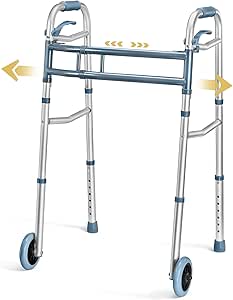 | Best for Buyers Prioritizing Capacity | Material: Aluminum | Weight capacity: Up to 350 pounds | Wheels: Yes | VIEW LATEST PRICE | See Our Full Breakdown |
| VOCIC Z21 Rollator Walker for Seniors with Seat and 8-Inch All-Terrain Wheels |  | Best for Outdoor Terrain | Weight: About 22 lb | Maximum user weight: 350 lb | Recommended user height: 4 ft 11 in–6 ft 3 in | VIEW LATEST PRICE | See Our Full Breakdown |
| HOMLAND Foldable 3-Wheel Walker for Seniors, 11 lb |  | Best Compact Three-Wheel Pick | Weight: 11 lbs | Weight capacity: 260 lbs | Handle height: 34–38 inches | VIEW LATEST PRICE | See Our Full Breakdown |
| Stander Space Saver Folding Rollator with Seat, Cobalt Blue |  | Best for Compact Storage | Walker type: Rollator | Frame material: Aluminum | Weight: 14.5 pounds | VIEW LATEST PRICE | See Our Full Breakdown |
| Vive Ultra Lightweight Rollator Walker with Seat |  | Best Lightweight Rollator with Higher Capacity | Weight: 14 pounds | Maximum user weight: 300 pounds | Handle height range: 31–36 inches | VIEW LATEST PRICE | See Our Full Breakdown |
| Stander Space Saver Walker, Lightweight Folding Mobility Aid with 6-inch Wheels |  | Best for Minimal Storage and Simple Support | Walker type: Folding mobility walker | Weight: 8 pounds | Weight capacity: 300 pounds | VIEW LATEST PRICE | See Our Full Breakdown |
| Loyoda Folding Walker with Skis and 5″ Wheels |  | Best for Adaptable Contact Options | Walker type: Folding walker | Color: Black | Wheel size: 5 inches | VIEW LATEST PRICE | See Our Full Breakdown |
| Medline Lightweight Two-Button Folding Walker with 5-Inch Wheels |  | Best for Narrow Spaces | Frame material: Aluminum | Weight: 6 pounds | Weight capacity: 300 pounds | VIEW LATEST PRICE | See Our Full Breakdown |
| lightweight walkers for senior | Wheel size | Weight capacity | Weight | Frame material |
|---|---|---|---|---|
| Vive Mobility Three-Wheel Roll | — | — | — | — |
| HOMLAND Foldable Rollator Walk | 8 inches | — | — | High-strength alloy |
| Caring 4-Wheel Rollator Walker | — | 350 lbs | — | Steel |
| PLANET WALK Super Lightweight | 8 inches | — | 13 lbs | Aluminum alloy |
| Vive Mobility Lightweight Fold | 6 inches | 300 lbs | 9.5 lbs | High-strength aluminum |
| Drive Medical Rollator Walker | 7.5 inches | 350 lbs | — | Steel |
| Medline Superlight Folding Alu | 6 inches | 250 lbs | 12.6 lbs | Aluminum |
| Lightweight Aluminum Walker wi | — | Up to 350 pounds | — | — |
| VOCIC Z21 Rollator Walker for | 8 in | — | About 22 lb | — |
| HOMLAND Foldable 3-Wheel Walke | 8 inches | 260 lbs | 11 lbs | — |
| Stander Space Saver Folding Ro | 6 inches | 250 pounds | 14.5 pounds | Aluminum |
| Vive Ultra Lightweight Rollato | 6 inches | — | 14 pounds | — |
| Stander Space Saver Walker | 6 inches | 300 pounds | 8 pounds | Aluminum |
| Loyoda Folding Walker with Ski | 5 inches | Not specified | Not specified | — |
| Medline Lightweight Two-Button | 5 inches | 300 pounds | 6 pounds | Aluminum |
More Details on Our Top Picks
Vive Mobility Three-Wheel Rollator Walker for Seniors
The Vive Mobility is the most compact-style rollator in this group, pairing a foldable three-wheel frame with height-adjustable handles and a removable storage bag. That setup suits errands and car trips where a narrower-feeling design and easy packing matter more than having a place to sit. Compared with the four-wheel PLANET WALK Super Lightweight Rollator, it has no listed seat or backrest, but its three-wheel layout may be easier to steer through tighter routes. The tradeoff is support: a three-wheel walker generally offers less stability than a four-wheel design, so it may not suit someone who relies heavily on a broad, steady base. The lifetime guarantee adds reassurance, though product data does not specify its weight or folded dimensions.
Pros:- Foldable design supports storage and car transport
- Height-adjustable handles allow a more personalized fit
- Removable, easy-to-clean bag carries everyday items
- Lifetime guarantee
Cons:- Three-wheel layout may provide less support than four-wheel rollators
- No seat or backrest is listed for resting
- Weight and folded dimensions are not provided, limiting transport comparisons
Best for: Seniors who want a foldable rollator with a storage bag for errands and vehicle transport, and who feel steady using a three-wheel design.
Not ideal for: People who need the added stability of four wheels or want a built-in seat for planned rest breaks.
- Type:Three-wheel rollator walker
- Design:Foldable and lightweight
- Handles:Height adjustable
- Storage:Removable, easy-to-clean grey bag
- Guarantee:Lifetime guarantee
- Seat:Not listed
Our verdict“Choose the Vive Mobility if compact folding and a removable bag matter more to you than a seat or the broader support of four wheels.”
HOMLAND Foldable Rollator Walker for Seniors with Seat
The HOMLAND is the strongest fit here for shoppers who prioritize a roomy seat and broad height adjustment over a very light frame. Its 16 x 12-inch cushioned seat and listed user-height range of 4’7″ to 6’6″ make it more accommodating than the seatless Vive Mobility folding walker. The 8-inch puncture-proof wheels also offer more clearance for thresholds and uneven paths than that walker’s 6-inch wheels. Three braking modes give the user options for rolling, slowing, or stopping, while the quick-fold design helps with storage. The cost of this fuller-featured setup is practical: at 20.4 pounds, it may be harder to lift into a car than the 13-pound PLANET WALK. Its 22-inch frame width can also challenge narrow doorways.
Pros:- Wide cushioned seat provides room for rest breaks
- Listed user-height range spans 4’7″ to 6’6″
- 8-inch puncture-proof wheels help with thresholds and uneven surfaces
- Three-mode braking and quick-fold design add use flexibility
Cons:- At 20.4 pounds, it may be difficult for some users to lift into a vehicle
- 22-inch frame width may restrict passage through narrow doorways
- Heavier than the 13-pound PLANET WALK option
Best for: Seniors across a wide range of heights who want a cushioned resting seat, larger wheels, and adjustable braking for indoor and outdoor routines.
Not ideal for: People who must lift a walker into a vehicle frequently or move through especially narrow doorways and compact indoor spaces.
- Frame material:High-strength alloy
- Seat dimensions:16 x 12 inches
- Seat height range:20–23 inches
- Handle height range:33–40 inches
- Listed user height range:4’7″–6’6″
- Wheel size:8 inches
- Product weight:20.4 lbs
- Folded dimensions:39 x 25 x 11.5 inches
- Braking system:3-mode: free, deceleration, and stop
Our verdict“Pick the HOMLAND if seat comfort and a wide height range matter more than keeping lift weight and frame width to a minimum.”
Caring 4-Wheel Rollator Walker for Seniors – Blue Rolling Walker with Seat, Hand Brakes & Storage
The Caring rollator earns its place for shoppers who need a stated 350-pound weight capacity alongside a seat and storage. Its four-wheel layout, padded seat, and hand brakes make it a more complete choice for outings with planned rest stops than the seatless Vive Mobility folding walker. The tradeoff for that sturdy steel frame is likely to be more lifting effort than with the 13-pound aluminum PLANET WALK; the Caring model’s exact weight is not listed, so buyers should check handling needs before relying on it for frequent car loading. Its large wheels are presented as useful for mobility, but may feel less nimble in very tight indoor spaces. The foldable frame supports storage and travel, though the available specifications do not give dimensions or an adjustment range.
Pros:- Listed weight capacity of 350 pounds
- Four-wheel design includes a padded seat for rest breaks
- Ergonomic hand brakes support controlled stopping
- Foldable frame and storage pouch suit outings and everyday carry
Cons:- Steel frame may be heavier to lift than aluminum alternatives
- Large wheels may be less nimble in tight indoor areas
- Product weight and folded dimensions are not provided
Best for: Seniors who need a rollator rated to support up to 350 pounds and want both a padded seat and a storage pouch.
Not ideal for: People who need a confirmed low-lift-weight walker or frequently maneuver through tight indoor spaces.
- Frame material:Steel
- Weight capacity:350 lbs
- Wheel count:4
- Seat:Padded
- Brakes:Ergonomic hand brakes
- Storage:Storage pouch
- Foldable:Yes
- Color:Royal Blue
Our verdict“Choose the Caring rollator if its 350-pound capacity and seated-rest features outweigh the uncertainty around lifting weight and compact fit.”
PLANET WALK Super Lightweight Rollator Walker for Seniors
At 13 pounds, the PLANET WALK is the clearest balance in this group for seniors who want a seat without taking on the weight of a heavier rollator. Its aluminum frame, one-hand folding mechanism, breathable seat, and backrest make it more complete for outings than the 9.5-pound Vive Mobility folding walker, which has no seat. The 8-inch rubber wheels and dual brakes add capability for varied surfaces and controlled stops, while five height settings provide some fit adjustment. The main limitation is fit: the listed user-height range ends at 5.8 feet, so taller buyers may find the HOMLAND’s broader stated range more suitable. Its 300-pound capacity is also lower than the Caring rollator’s 350 pounds. For travel, low lifting weight is its defining advantage, not maximum capacity.
Pros:- 13-pound aluminum frame is easier to lift than the 20.4-pound HOMLAND
- One-hand folding supports quick storage in a vehicle
- Seat and backrest provide a place to rest during outings
- 8-inch rubber wheels and dual brakes suit varied surfaces
Cons:- Listed user-height range tops out at 5.8 feet
- 300-pound capacity is below the Caring rollator’s 350-pound rating
- Light aluminum frame may transmit more vibration on rough terrain
Best for: Seniors up to the listed 5.8-foot height range who want a light, seat-equipped rollator for travel and everyday outings.
Not ideal for: Taller users, people needing capacity above 300 pounds, or buyers who prefer a heavier frame for rough-surface comfort.
- Weight:13 lbs
- Maximum user weight:300 lbs
- Frame material:Aluminum alloy
- Wheel size:8 inches
- Folded dimensions:26.5 x 10.9 x 35 inches
- Handle height range:35–39 inches
- Listed user height range:4.8–5.8 ft
- Seat width:18.5 inches
- Brakes:Dual-brake system
Our verdict“The PLANET WALK is the best fit for buyers who want a genuinely light, foldable rollator with a seat and fall within its listed height and capacity limits.”
Vive Mobility Lightweight Folding Walker for Seniors, 9.5 lb
This Vive Mobility walker is the lightest listed option in this batch at 9.5 pounds, and its narrow, open frame is a specific advantage for homes with tight turns or doorways. Unlike the seated PLANET WALK, it has no place to rest, but it weighs 3.5 pounds less and uses a one-step fold with a locking system for straightforward storage. Adjustable handles, ergonomic grips, and hand brakes support a more tailored walking setup; the 6-inch wheels are smaller than the 8-inch wheels on the HOMLAND, so buyers prioritizing clearance over thresholds may prefer that rollator. The 300-pound capacity is clearly stated, and the lifetime frame guarantee adds confidence, but this is a basic walking aid rather than a seated rollator for longer outings.
Pros:- 9.5-pound frame is the lightest listed in this batch
- Narrow, open frame supports movement through tighter spaces
- One-step folding with a locking system simplifies storage
- Adjustable handles, hand brakes, and lifetime frame guarantee
Cons:- No seat for resting during longer outings
- 6-inch wheels are smaller than those on the HOMLAND and PLANET WALK
- Maximum supported weight is 300 pounds
Best for: Seniors who need a lightweight, narrow-frame walker for home use and occasional transport, and do not need a seat.
Not ideal for: People who need a built-in resting seat, larger wheels for more clearance, or capacity above 300 pounds.
- Weight:9.5 lbs
- Weight capacity:300 lbs
- Frame material:High-strength aluminum
- Handle height:33–39 inches, adjustable
- Wheel size:6 inches
- Frame design:Narrow, open frame
- Folding:One-step fold with locking system
- Assembly:Pre-assembled
- Guarantee and eligibility:Lifetime frame guarantee; FSA/HSA approved
Our verdict“Choose this Vive Mobility walker for a light, narrow, seatless frame that prioritizes indoor maneuverability over rollator-style rest features.”
Drive Medical Rollator Walker with Seat and 7.5 Inch Wheels, Blue
The Drive Medical stands out for buyers who want a seated rollator with a 350 lb capacity and a sturdier steel frame. Its 7.5-inch wheels are larger than the Medline Superlight’s 6-inch wheels, which can make everyday rolling over small thresholds feel less abrupt, though neither model is intended for very rough ground. A padded seat, hinged backrest, locking hand brakes, and under-seat pouch give it the practical features expected for errands and rest breaks. The tradeoff is portability: steel may be more demanding to lift than Medline’s 12.6 lb aluminum frame, and no product weight is provided here. I’d choose this over the VOCIC Z21 when capacity and a simpler feature set matter more than larger all-terrain wheels and adjustable braking modes.
Pros:- 350 lb capacity offers more supported user weight than the Medline Superlight’s 250 lb limit.
- 7.5-inch wheels are larger than the Medline Superlight’s 6-inch wheels.
- Padded seat and hinged backrest provide a place to rest.
- Folds for storage and includes an under-seat pouch.
Cons:- Steel construction may be harder to lift and transport than an aluminum model.
- Fixed 7.5-inch wheels may not suit very rough terrain.
- Product weight is not specified, making transport effort harder to judge.
Best for: Seniors who want a seated rollator with a 350 lb capacity for everyday indoor and outdoor routes and do not need the lightest frame.
Not ideal for: People who regularly lift a walker into a car or need extra traction and clearance on rough paths; its steel frame may be heavier, and the 7.5-inch wheels have stated terrain limits.
- Brand:Drive Medical
- Frame material:Steel
- Weight capacity:350 lbs
- Wheel size:7.5 inches
- Seat:Padded
- Backrest:Removable hinged backrest
- Brakes:Hand brakes with locking mechanism
- Folding:Yes
- Color:Blue
Our verdict“Choose the Drive Medical if you want a seated rollator with a 350 lb capacity and can accept a potentially heavier steel frame.”
Medline Superlight Folding Aluminum Rollator Walker, Smoky Blue
At 12.6 lb, the Medline Superlight is the clearest choice here for someone who needs a four-wheel rollator that is easier to lift and fold for transport. Its aluminum frame is much lighter than the VOCIC Z21 at about 22 lb, but that reduction comes with a lower 250 lb capacity and smaller 6-inch wheels. The adjustable padded seat and handles help tailor the fit, while push-down wheel locks keep the rollator still for sitting or standing. The 12 x 12-inch seat may feel restrictive to some users, and its wheels are less suited to rougher paths than the VOCIC’s 8-inch puncture-proof tires. I’d favor it for frequent car trips and smoother routes, not for buyers who need greater capacity or more terrain clearance.
Pros:- At 12.6 lb, it is lighter than the VOCIC Z21, listed at about 22 lb.
- Aluminum frame folds for storage and transport.
- Seat and handle heights are adjustable for a more tailored fit.
- Push-down wheel locks help keep it stationary during seated breaks.
Cons:- 250 lb capacity is lower than the 350 lb limits of the Drive Medical and VOCIC Z21.
- The 12 x 12-inch seat may feel small for some users.
- Six-inch wheels offer less clearance than the VOCIC Z21’s 8-inch wheels.
Best for: Seniors who often load a rollator into a vehicle and want a light aluminum frame, adjustable seating, and a four-wheel design.
Not ideal for: Users above 250 lb, people who need a roomier seat, or those who regularly travel over uneven outdoor paths.
- Frame material:Aluminum
- Weight:12.6 lbs
- Weight capacity:250 lbs
- Wheel size:6 inches
- Seat dimensions:12 x 12 inches
- Seat height:18–23 inches
- Handle height:29.5–36 inches
- Storage:Under-seat storage
- Brakes:Hand brakes with push-down wheel locks
Our verdict“Pick the Medline Superlight if easier lifting and car transport matter more than higher capacity, a larger seat, or larger wheels.”
Lightweight Aluminum Walker with Wheels for Seniors
This aluminum walker’s standout stated advantage is its 350 lb capacity alongside a lightweight frame. That combination may appeal to buyers who cannot use the Medline Superlight’s 250 lb limit but still want to avoid a steel-frame option like the Drive Medical. The available details, however, are sparse: they confirm wheels but do not give a wheel size, product weight, seat, brakes, folding method, or height adjustments. That makes it difficult to judge whether it will suit longer outings, provide seated rest, or fit a particular user. Compared with the feature-rich VOCIC Z21, this is a much less specified choice rather than a clear all-terrain alternative. I’d shortlist it only after confirming the missing fit and safety details with the seller.
Pros:- Aluminum construction is described as lightweight.
- Stated capacity of up to 350 lb exceeds the Medline Superlight’s 250 lb limit.
- Wheels support rolling mobility.
Cons:- Product weight is not provided, so its liftability cannot be compared reliably with the 12.6 lb Medline.
- Wheel size and tire type are unspecified, making terrain suitability unclear.
- No seat, braking, folding, or adjustment details are supplied.
Best for: Seniors seeking an aluminum wheeled walker with a stated capacity up to 350 lb who can verify fit, braking, and other features before buying.
Not ideal for: Buyers who need a seat, known product weight, specified wheel size, or documented brake and height-adjustment details to choose confidently.
- Material:Aluminum
- Weight capacity:Up to 350 pounds
- Wheels:Yes
Our verdict“Consider this walker only if its stated 350 lb capacity fits your needs and you can confirm its missing fit and safety specifications first.”
VOCIC Z21 Rollator Walker for Seniors with Seat and 8-Inch All-Terrain Wheels
The VOCIC Z21 puts more emphasis on outdoor capability than the lighter Medline Superlight: its 8-inch puncture-proof wheels are larger than Medline’s 6-inch wheels and are designed for varied terrain. The tradeoff is weight. At about 22 lb, it may be harder to lift into a car than the 12.6 lb Medline, even though it folds. Its adjustable seat and handles cover a broad stated user-height range, while the three-mode brakes let users select free rolling, deceleration, or stopping. A waterproof padded seat, breathable backrest, and reflective strips add practical comfort and visibility features. For buyers focused on smoother surfaces and easy lifting, Medline is the more portable pick; I’d choose the VOCIC when larger wheels and the broader feature set matter more.
Pros:- Eight-inch puncture-proof wheels are larger than those on the Medline Superlight.
- Adjustable seat and handle heights accommodate a stated range of user heights.
- Three braking modes offer free rolling, deceleration, and stopping options.
- Waterproof padded seat, breathable backrest, and reflective strips add useful features.
Cons:- At about 22 lb, it is considerably heavier than the 12.6 lb Medline Superlight.
- The frame and braking components need to be checked for correct setup before use.
- Its listed folded dimensions may still require substantial storage space.
Best for: Seniors within the stated height range who want larger puncture-proof wheels, adjustable seating, and braking modes for mixed outdoor and indoor routes.
Not ideal for: People who need to lift a rollator frequently or cannot manage a 22 lb frame; the Medline Superlight is substantially lighter.
- Weight:About 22 lb
- Maximum user weight:350 lb
- Recommended user height:4 ft 11 in–6 ft 3 in
- Wheel size:8 in
- Tire type:Puncture-proof
- Seat height:Adjustable, 20–22 in (3 levels)
- Handle height:Adjustable, 31.5–36.6 in (5 levels)
- Braking modes:Free, deceleration, stop
- Folded dimensions:31.5 × 23.6 × 13.8 in
Our verdict“Choose the VOCIC Z21 for larger wheels and adjustable outdoor-oriented features if you can handle its heavier frame.”
HOMLAND Foldable 3-Wheel Walker for Seniors, 11 lb
At 11 lb, this HOMLAND is the lightest option in this group with a stated weight, and its three-wheel layout favors compact maneuvering over the seated support offered by the Drive Medical, Medline, and VOCIC. It folds one-handed and can stand while folded, which may simplify storage in a home or vehicle. The 8-inch wheels, adjustable handles, storage pouch, cane holder, and cup holder add practical detail for users who do not need a seat. Its 260 lb capacity is lower than the 350 lb limits on the Drive Medical and VOCIC, and the product is specifically not designed to support users getting into or out of vehicles. I’d pick it for portability and everyday organization, but choose a four-wheel seated rollator if resting support is part of the need.
Pros:- At 11 lb, it is lighter than the Medline Superlight at 12.6 lb and VOCIC Z21 at about 22 lb.
- One-hand folding and a stand-when-folded design help with storage.
- Eight-inch wheels and adjustable handles support everyday mobility across the stated height range.
- Includes a storage pouch, cane holder, and cup holder.
Cons:- 260 lb capacity is below the 350 lb limits of the Drive Medical and VOCIC Z21.
- Three-wheel design does not include the seated rest option found on those four-wheel rollators.
- Not designed to support users entering or exiting vehicles.
Best for: Seniors who want a very light, compact three-wheel walker for maneuvering and storage, and who do not need an integrated seat.
Not ideal for: Users who need a seat for resting, require more than 260 lb capacity, or want to use the walker for support while entering or exiting a vehicle.
- Weight:11 lbs
- Weight capacity:260 lbs
- Handle height:34–38 inches
- Suggested user height:4 ft 8 in–6 ft 1 in
- Wheel size:8 inches
- Folding design:Two-side folding; one-hand fold; stands when folded
- Included features:Storage pouch, cane holder, cup holder
- Warranty:1 year plus 1-year extension service
Our verdict“Choose this HOMLAND for light lifting and compact three-wheel maneuvering, but not if you need a seat or vehicle-transfer support.”
Stander Space Saver Folding Rollator with Seat, Cobalt Blue
The Stander Space Saver Rollator is the clearest choice here when storage space matters: it folds to a 10 × 11-inch footprint, far smaller than a typical full-size rollator. At 14.5 pounds, it is still portable, though the Vive Ultra Lightweight Rollator is slightly lighter at 14 pounds and carries a higher 300-pound capacity. This Stander supports up to 250 pounds and has a perch seat with a back strap for brief rests, rather than the roomier seated setup some buyers may prefer. Adjustable padded handles and rear locking brakes add useful control for indoor and outdoor use. Its main compromise is that the compact seat is better for short pauses than extended sitting; shoppers prioritizing seat space or higher capacity should compare the Vive.
Pros:- Folds to a compact 10 × 11-inch footprint for storage and travel
- Pre-assembled, so setup is not required
- Adjustable padded handles and rear locking brakes support everyday control
- Perch seat and back strap provide a place for short rests
Cons:- Compact perch seat is less suited to extended sitting
- 250-pound weight capacity is lower than the Vive Ultra Lightweight Rollator’s 300-pound limit
Best for: Seniors with limited closet or vehicle storage who want a rollator that folds very small and need a perch for brief rests.
Not ideal for: Users who need a broad seat for longer breaks or require support above 250 pounds; the Vive Ultra Lightweight Rollator offers a higher capacity.
- Walker type:Rollator
- Frame material:Aluminum
- Weight:14.5 pounds
- Folded footprint:10 × 11 inches
- Seat dimensions:18.5 × 6 inches
- Wheel size:6 inches
- Handle height:33–36 inches
- Weight capacity:250 pounds
- Assembly:Pre-assembled
Our verdict“Choose this Stander if a very small folded footprint matters more than a larger seat or higher weight capacity.”
Vive Ultra Lightweight Rollator Walker with Seat
The Vive Ultra Lightweight Rollator pairs a 14-pound frame with a 300-pound capacity, making it a stronger fit than the Stander Space Saver for buyers who want a light rollator without its 250-pound limit. It also has a padded seat and backrest, plus underseat storage for carrying everyday items. Its 14 × 12-inch seat is more substantial than the Stander’s narrow perch, though the frame is compact and may feel restrictive for larger users. Tool-free assembly helps keep setup simple, and the 31–36-inch handle range offers some flexibility. The fixed 6-inch wheels are the tradeoff: they suit routine indoor use and smoother paths better than rough outdoor routes, where larger wheels such as those on the VOCIC Z21 may be preferable.
Pros:- 14-pound frame is easy to lift and transport
- Supports up to 300 pounds despite its light weight
- Padded seat, backrest, and underseat storage support outings and errands
- Tool-free assembly and folding design simplify setup and storage
Cons:- Fixed 6-inch wheels may be less capable on rough or uneven outdoor surfaces
- Compact frame may feel restrictive for larger users
Best for: Seniors who want a light, foldable rollator with a backrest, underseat storage, and a 300-pound capacity for daily errands.
Not ideal for: Larger users who need a roomier frame or people who regularly travel over rough outdoor terrain; its compact build and 6-inch wheels may feel limiting.
- Weight:14 pounds
- Maximum user weight:300 pounds
- Handle height range:31–36 inches
- Frame dimensions:24 inches wide × 23 inches deep
- Seat dimensions:14 × 12 inches
- Seat height:21 inches
- Wheel size:6 inches
- Assembly:No tools required
- Warranty:1-year guarantee
Our verdict“Pick the Vive for a light everyday rollator with a backrest and higher capacity, provided its compact fit and small wheels suit your needs.”
Stander Space Saver Walker, Lightweight Folding Mobility Aid with 6-inch Wheels
At 8 pounds, the Stander Space Saver is the lightest option in this group, and its 5 × 7-inch folded footprint makes it unusually easy to tuck away or load into a vehicle. Unlike the seated Vive rollator, this is a basic walker without a seat, so it favors steady support and portability over rest breaks and storage for personal items. It supports up to 300 pounds and arrives pre-assembled with adjustable padded handles. Fixed front wheels and rear ski glides help it move across indoor floors, but they offer less turning freedom than the independently folding Medline two-button walker, and the glides may feel less secure on uneven outdoor ground. This is a focused choice for users who value a light, compact frame more than rollator-style convenience.
Pros:- At 8 pounds, it is easy to lift and load
- Folds to a very small 5 × 7-inch footprint
- Supports up to 300 pounds
- Pre-assembled design and adjustable padded handles reduce setup and fit hassles
Cons:- No seat or underseat storage for outings that call for rest breaks
- Fixed front wheels can make tight turns less convenient
- Rear ski glides may provide limited grip on uneven outdoor terrain
Best for: Seniors who need a very light walker for indoor support and vehicle travel, and who have little storage space.
Not ideal for: Users who want a seat, need easy turning in tight spaces, or often walk on uneven outdoor surfaces; the fixed wheels and ski glides have limits there.
- Walker type:Folding mobility walker
- Weight:8 pounds
- Weight capacity:300 pounds
- Frame material:Aluminum
- Folded footprint:5 × 7 inches
- Handle height range:32.5–39 inches
- Wheel size:6 inches
- Front and rear supports:Fixed front wheels and rear ski glides
- Assembly:Pre-assembled
Our verdict“Choose this Stander if the lightest frame and smallest folded size matter more than a seat or nimble turning.”
Loyoda Folding Walker with Skis and 5″ Wheels
The Loyoda’s point of difference is its set of interchangeable skis and 5-inch wheels, giving buyers a way to adapt the walker to different surfaces. That flexibility sets it apart from the Stander Space Saver, which has fixed front wheels and rear ski glides, and the Medline, which specifies 5-inch wheels but no interchangeable skis. Loyoda also describes an upgraded handle intended to improve stability. Still, the supplied product information leaves out key details such as frame weight, capacity, and height adjustment range, making fit and lifting effort harder to judge than with the Stander or Medline. Swapping parts may also take extra work, so this is a less straightforward pick for someone who wants a ready-to-use walker with clearly documented specifications.
Pros:- Interchangeable skis and 5-inch wheels offer flexibility across surfaces
- Lightweight design is intended to support easier maneuvering
- Upgraded handle is designed to improve stability
- Folding format supports storage
Cons:- Product data does not specify frame weight or weight capacity
- No handle-height range is provided to confirm fit
- Changing between skis and wheels may require part swapping
Best for: Seniors or caregivers who want the option to switch between skis and wheels for different walking surfaces and can confirm fit and capacity before buying.
Not ideal for: Buyers who need a known frame weight, weight capacity, or height range before choosing, or who want to avoid swapping walker parts.
- Walker type:Folding walker
- Color:Black
- Wheel size:5 inches
- Included contact options:Interchangeable skis and wheels
- Handle:Upgraded design intended for enhanced stability
- Weight:Not specified
- Weight capacity:Not specified
Our verdict“Consider the Loyoda if interchangeable skis and wheels suit your routes, but confirm weight, capacity, and fit details before choosing it.”
Medline Lightweight Two-Button Folding Walker with 5-Inch Wheels
The Medline Two-Button Walker stands out for users who need a light, practical frame that can negotiate narrow spaces. At 6 pounds, it is lighter than the 8-pound Stander Space Saver, while its independently folding sides can make storage and movement through tight areas easier. The two-button mechanism is designed for straightforward folding, and ergonomic grips may help reduce hand fatigue during use. Its 300-pound capacity matches the Stander Space Saver Walker, though Medline provides a more specific fit guide: a 32–38-inch height range and a recommended user height of 5 feet 5 inches to 6 feet 4 inches. The tradeoff is that it lacks a seat, and its stated fit range may exclude shorter or taller users. Its 5-inch wheels are smaller than the Stander’s 6-inch wheels.
Pros:- 6-pound aluminum frame is easy to carry
- Each side folds independently for narrow spaces and storage
- Height adjusts from 32 to 38 inches
- Supports up to 300 pounds and has ergonomic grips designed to reduce hand fatigue
Cons:- Recommended user-height range may not suit shorter or taller adults
- No seat is provided for resting during walks
- 5-inch wheels are smaller than the Stander Space Saver Walker’s 6-inch wheels
Best for: Adults within the stated height range who need a lightweight walker that can fold at each side for narrow hallways or compact storage.
Not ideal for: Users outside the recommended 5-foot-5-inch to 6-foot-4-inch height range or anyone who wants a built-in seat for rest breaks.
- Frame material:Aluminum
- Weight:6 pounds
- Weight capacity:300 pounds
- Wheel size:5 inches
- Height range:32–38 inches
- Recommended user height:5 feet 5 inches–6 feet 4 inches
- Width between grips:17 inches
- Folding mechanism:Two-button; each side folds independently
Our verdict“Choose the Medline if you need a very light walker with independently folding sides and fall within its stated height range.”

How We Picked
I compared the 15 listed walkers around the choices that matter most to seniors and caregivers: overall weight, folding and storage, support style, wheel setup, seating, and likely day-to-day usability. I also considered how the design fits common routines, from moving through a home to carrying a walker in a vehicle or taking it outdoors. A walker’s advertised lightness matters only if the person can control it safely and use its supports comfortably.
The ranking favors options that balance useful features with manageable handling rather than rewarding a single specification. Rollators with seats rank well for users who benefit from rest breaks, while simpler folding frames have a clearer role for people who want less equipment and more controlled support. Three-wheel and compact designs trade some seating or stability for maneuverability and storage; larger-wheel models make more sense when routes are less smooth. I treat these as different mobility needs, not interchangeable versions of one product.
| lightweight walkers for senior | Frame material |
|---|---|
| Vive Mobility Three-Wheel Roll | — |
| HOMLAND Foldable Rollator Walk | High-strength alloy |
| Caring 4-Wheel Rollator Walker | Steel |
| PLANET WALK Super Lightweight | Aluminum alloy |
| Vive Mobility Lightweight Fold | High-strength aluminum |
| Drive Medical Rollator Walker | Steel |
| Medline Superlight Folding Alu | Aluminum |
| Lightweight Aluminum Walker wi | — |
| VOCIC Z21 Rollator Walker for | — |
| HOMLAND Foldable 3-Wheel Walke | — |
| Stander Space Saver Folding Ro | Aluminum |
| Vive Ultra Lightweight Rollato | — |
| Stander Space Saver Walker | Aluminum |
| Loyoda Folding Walker with Ski | — |
| Medline Lightweight Two-Button | Aluminum |
Factors to Consider When Choosing Lightweight Walkers For Seniors
Before choosing a lightweight walker, match its design to the user’s balance, strength, surroundings, and usual routes. A low weight can make lifting easier, but it does not automatically make a walker safer or more comfortable. These broader checks can help narrow the options before comparing individual models.
Choose the support style before comparing weights
Start by deciding whether the user needs a standard walker, a two-wheel walker, or a rollator. A standard frame is lifted and repositioned, while a two-wheel design rolls forward at the front; a rollator generally rolls on four wheels and is steered with hand brakes. These designs ask different things of balance, coordination, and grip strength. A common mistake is choosing a rollator because it moves easily, even when the user needs a frame that cannot roll away as readily. Ask a physical therapist or clinician for guidance if balance is uncertain or the user has recently fallen. The lightest option is a poor match if its movement pattern feels difficult to control.
Measure the home and the user, not just the folded frame
Check doorway widths, bathroom turns, elevator space, and the area beside the usual chair or bed. A walker that folds compactly may still be too wide to steer comfortably through the home, and a narrow model may feel restrictive for the user. Handle height should allow a relaxed, upright posture rather than hunched shoulders or locked elbows. If the walker has a seat, check seat height and width as well as whether the user can sit down and stand up safely. Measure the vehicle’s trunk or storage space separately; folded dimensions and lifting weight are different concerns. When possible, confirm that the chosen model can be adjusted to the user’s measurements.
Treat a rollator seat as a rest feature, not a transport seat
A seat can help someone pause during walks, but the user needs to apply the brakes and park the rollator on stable ground before sitting. A seat does not make the walker appropriate for carrying someone while it is moving. Think about where rests are likely to happen: indoor hallways, paved paths, or longer outings with limited places to sit. Seat height, back support, and the effort needed to turn and sit down can matter more than the presence of a seat alone. Buyers sometimes choose a seated model without checking whether the user can manage its hand brakes. If the user cannot reliably operate those brakes, discuss safer alternatives with a mobility professional.
Match wheel size and design to the actual route
Small wheels can be easier to manage on smooth indoor floors, but thresholds, cracked pavement, and loose surfaces can interrupt movement. Larger wheels may roll more readily over uneven ground, yet they can add bulk and make tight indoor turns harder. Think through the route the user takes most often rather than shopping for the roughest surface they might encounter once. Check door thresholds, rugs, outdoor paths, and the distance between resting places. A walker that handles one surface well may be awkward on another, so compromises are normal. If outdoor use is frequent, a supervised trial on similar ground can reveal handling issues that a feature list cannot.
Balance lightness against stability and control
Lower weight can make a walker easier to lift into a car or move around the home, but it does not tell you how steady the frame feels when loaded or turning. Consider the user’s strength, grip, coordination, and ability to control the walker at a safe pace. Review the manufacturer’s user-weight limit, braking instructions, and adjustment guidance rather than assuming that a lightweight frame suits every body type. Check that folding locks engage as intended and that brakes can be reached without strain. A very compact design can feel less reassuring to someone who leans heavily on the frame. If steadiness is the main concern, ask a clinician to help compare a lighter model with a more supportive alternative.
Plan for lifting, folding, and ongoing upkeep
Portability depends on more than the walker’s listed weight: the user must also be able to fold it, lift it from the right points, and secure it for storage or travel. Caregivers should test those tasks too, especially if they will load the walker into a vehicle regularly. Rollators may require checks of brake function, wheel condition, fasteners, and folding mechanisms, while simpler frames have fewer moving parts to inspect. Read the care instructions and make sure replacement parts or service information are available if something wears out. Avoid carrying bags in a way that changes balance or blocks access to the brakes. A walker that is easy to maintain and handle every day may be a better purchase than one chosen for minimum weight alone.
Frequently Asked Questions
Is a rollator or a folding walker safer for someone with balance problems?
There is no single answer because the safest style depends on how the person walks and controls equipment. A rollator moves continuously and relies on the user to steer and operate its brakes; that can be difficult for someone who struggles with balance or hand control. A folding walker that must be lifted or repositioned can offer a more deliberate pace, but it requires enough strength and coordination to use correctly. A physical therapist or clinician can assess gait and recommend a suitable style. If possible, have the user try the walker in a supervised setting before relying on it at home.
Should I choose the lightest walker available?
Not necessarily. A lighter walker can be easier to lift, fold, and place in a vehicle, but weight alone does not show how stable or comfortable it will feel. The user’s ability to steer, use the brakes, and support their weight matters just as much. Compare the frame’s intended use, fit, weight limit, and handling alongside its weight. If a very light model feels difficult to control, a slightly heavier design may be the safer practical choice. A supervised trial can help resolve that tradeoff.
Do I need a seat, or is it better to buy a simpler walker?
A seat is useful when the person benefits from planned rest stops and can manage the rollator’s brakes before sitting. It also adds bulk and introduces another safety step: the walker must be parked on level ground and kept from rolling. A standard or two-wheel walker may suit someone who does not need to sit during walks or who needs a slower, more controlled support pattern. Consider how far the user typically walks, where they can rest, and whether they can safely turn and sit. A clinician can help determine whether a seated rollator fits the person’s mobility needs.
Are larger wheels worth choosing if most use will be indoors?
Larger wheels can help on cracked pavement or uneven paths, but they may take up more space and feel less convenient in tight rooms. For mostly smooth indoor floors, a smaller-wheel design may be easier to maneuver, provided it clears the thresholds and flooring in the home. Map the person’s regular routes, including doorways, rugs, and any outdoor sections, before deciding. If indoor and outdoor use are both frequent, prioritize the route that poses the greater safety challenge rather than assuming one wheel size will excel everywhere. A trial on the user’s actual surfaces is more informative than wheel size alone.
What should I check before buying a walker for someone who cannot easily lift it into a car?
Check the walker’s weight, folded dimensions, folding steps, and whether it can be lifted from a safe, comfortable position. The user may be able to guide a walker while walking but still lack the strength to lift it into a trunk, so test those tasks separately. A caregiver who handles transport should try folding and loading it as well. Consider whether the trunk opening is high, narrow, or difficult to reach; a compact folded profile may matter as much as a small weight difference. If lifting is not safe, plan for caregiver assistance or another transport arrangement rather than expecting the user to manage alone.
Conclusion
For most buyers seeking a versatile seated rollator, I recommend the HOMLAND Foldable Rollator Walker as the best overall starting point. The Medline Superlight Rollator is my best value-style pick for shoppers who want a lighter rollator format, while the VOCIC Z21 is the best match among these options for routes where larger wheels may help on uneven ground. For beginners who want a simpler support style, I would start with the Medline Two-Button Folding Walker and confirm fit with a clinician. The Stander Space Saver models make more sense when compact storage is the leading need; choose the rollator version if a seat matters and the wheeled walker if it does not. Buyers prioritizing minimum lifting weight should compare the lightweight Vive and HOMLAND three-wheel models, but should not trade away control or stability just to save weight. The best choice is the one the user can fit, steer, fold, and operate safely in the places they actually go.