
TL;DR

Turn quiet afternoons into listening time
- Thousands of audiobooks, podcasts and originals
- Listen on your phone, tablet or Echo — also offline
- Cancel anytime
Building an AI workstation isn’t always cheaper anymore. Prebuilts offer ready-to-go setups with validated thermals and support, while DIY gives you control and potential savings if you have the skills. Your choice depends on your needs for speed, support, and future upgrades.
If you’re eyeing a powerful AI workstation, the question isn’t just about specs anymore. It’s about whether you want a machine ready to run out of the box or a custom-built rig tailored exactly to your workflow. The landscape has shifted dramatically in 2026, making the decision more nuanced than ever. Build vs Buy a Prebuilt AI Workstation
With AI workloads demanding serious GPU power, thermal management, and support, understanding the real tradeoffs can save you money, time, and headaches. This guide breaks down the who, what, and why of building versus buying, so you can make the best call for your project and your wallet.
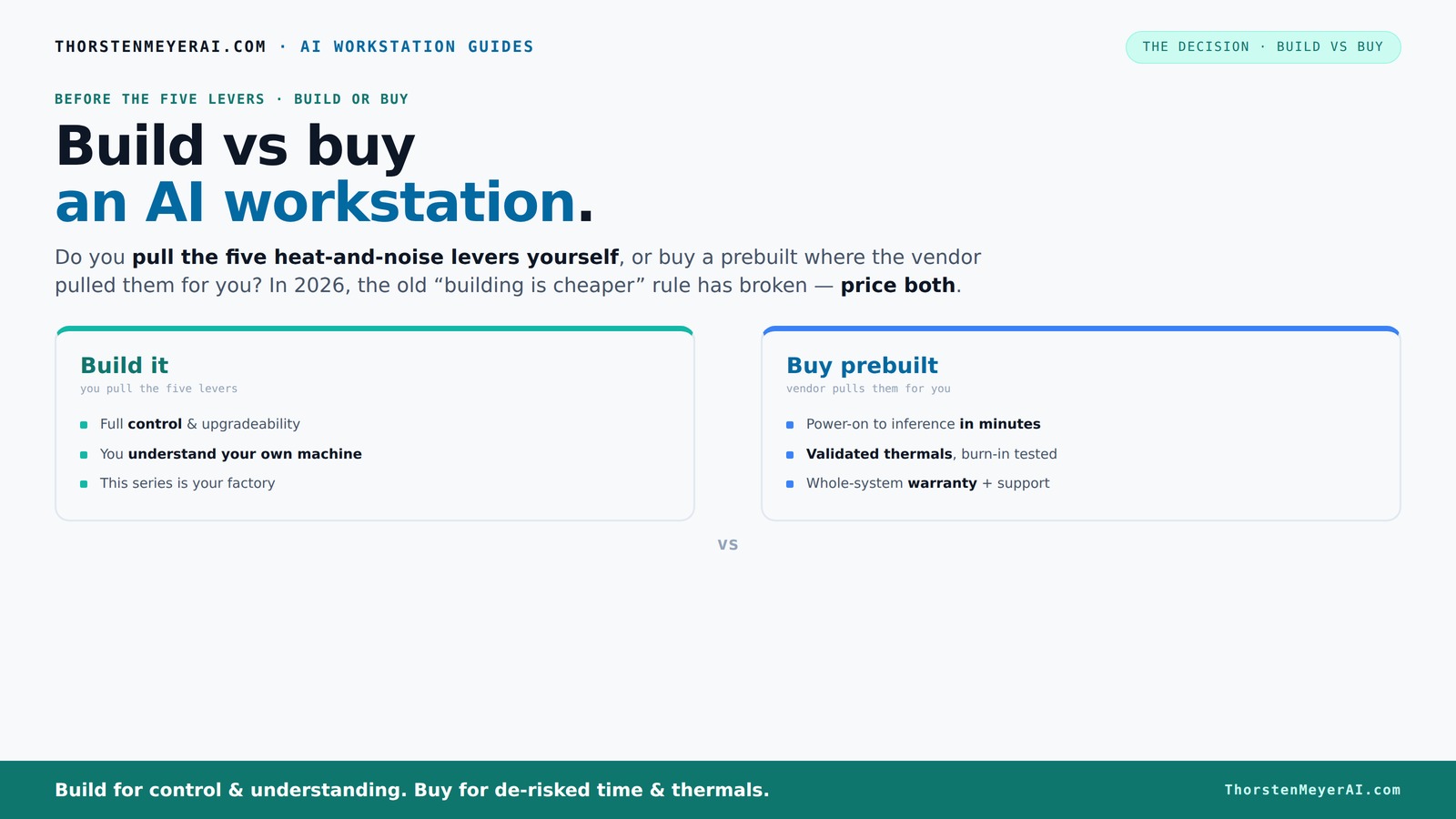
Build vs buy
an AI workstation.
The real question behind this whole series: do you pull the five heat-and-noise levers yourself, or buy a prebuilt where the vendor pulled them for you? And in 2026, the old “building is cheaper” rule has broken. Match your situation in Part 3.
Key Takeaways
- Component shortages in 2026 mean prebuilts often match or beat DIY prices for high-end AI workstations.
- Prebuilts offer validated thermals, support, and quick deployment—ideal for professionals on tight schedules.
- Building provides maximum control over parts, cooling, and upgrade paths, but requires time, expertise, and troubleshooting.
- Focus on GPU VRAM, power supply headroom, and cooling to optimize AI performance regardless of build or buy.
- Always compare total costs—consider hidden costs, downtime, and future upgrades—before deciding.
As an affiliate, we earn on qualifying purchases.
Why 2026 Changes Everything About Build vs Buy
Building your own AI workstation used to be the clear winner for cost—until recent market shifts. Component shortages, inflation, and bulk buying by major vendors have pushed prices for GPUs, DDR5 RAM, and SSDs higher. Build vs Buy a Prebuilt AI Workstation For example, a mid-range GPU that cost $500 in 2024 now often exceeds $750 due to supply constraints.
Meanwhile, prebuilt manufacturers like Lambda and BIZON have secured bulk discounts, allowing them to offer systems at prices that often match or beat DIY costs. So, in 2026, the old rule—"build cheaper"—no longer applies. Instead, the focus shifts to a detailed comparison of what each option offers in terms of value, support, and future-proofing.
This shift matters because it influences your decision's core: are you prioritizing initial cost savings or reliability and support? The increased costs and limited component availability mean that building your own may not always be the best choice, especially if you lack the time or expertise. Conversely, prebuilt systems, with their validated thermals and tested configurations, often provide a more predictable and less stressful route, especially for those who need to start working immediately or prefer guaranteed support. The implication is that the traditional cost advantage of DIY builds is diminishing, urging a more nuanced decision based on your specific needs and risk tolerance.
The Real Cost: Building vs Buying in 2026
Here’s a detailed comparison that digs into why these costs matter and what they mean in practice:
| Build | Buy |
|---|---|
| Lower upfront cost if you have time and skills. This can be appealing for hobbyists and enthusiasts who enjoy the process of tuning and optimizing their system, potentially saving money. However, the initial savings may be offset by hidden costs like troubleshooting, compatibility issues, and time investment. The tradeoff is that you get full control over every component, which can lead to a highly customized system optimized for your specific workloads. | Higher initial price due to assembly, validation, and support. Yet, this cost provides peace of mind: validated thermals mean fewer thermal issues, support reduces troubleshooting time, and warranties protect against hardware failures. For professionals or teams with tight deadlines, this reliability can translate into faster deployment and fewer disruptions. The implication is that while prebuilts might seem more expensive on paper, they can offer better value when factoring in time saved and minimized risk, especially as component shortages inflate DIY costs. |
Additionally, upgrade paths are a critical consideration. DIY systems typically offer more flexibility—adding RAM, swapping GPUs, or upgrading storage is straightforward. However, proprietary parts or limited expansion slots in some prebuilts can restrict future upgrades. The key is to evaluate not just the initial cost but also how the system will evolve over time, considering your projected needs and how much effort you’re willing to invest in upgrades. The tradeoff is clear: DIY offers maximum flexibility but requires ongoing effort, while prebuilts offer a more streamlined experience with some limitations on future scalability.
Who Should Build, Who Should Buy
Building is perfect if you crave control and customization. Power users and hobbyists who want specific GPUs, cooling setups, or upgrade flexibility will find DIY appealing. Plus, if you already know your way around hardware, you can fine-tune performance and noise levels exactly as you want. This approach is especially advantageous if you anticipate needing to upgrade components frequently or want to optimize for specific workloads, such as multi-GPU configurations or custom cooling solutions.
Buying a prebuilt makes sense if you need quick deployment, support, and reliability—especially for professional workloads. Companies like Lambda validate thermals, run stress tests, and offer warranties up to 5 years, which reduces the risk of hardware failure and minimizes downtime. For example, a researcher working under tight deadlines benefits from a prebuilt that is ready to go with minimal setup, ensuring their project timelines are met without the delays often associated with troubleshooting custom builds. The tradeoff here is convenience and peace of mind versus the control and customization of a DIY system.
Five Levers of Cooling and Noise — Who Pulls Them?
High-power AI workstations generate significant heat and noise, which can impact performance, comfort, and longevity. Managing these factors involves tuning five key levers: undervolting the GPU, matching the cooler to the CPU, optimizing airflow within the case, tuning fan curves, and strategic placement of components. These adjustments directly influence thermal performance and acoustic levels, impacting your system’s stability and your working environment.
When you buy a prebuilt, the vendor has already pulled these levers. They validate thermals, tune fan curves, and often include water-cooling or advanced air-cooling solutions that significantly reduce noise and temperature. This upfront optimization can save you hours of trial-and-error, leading to a quieter and more stable system from day one. For example, BIZON systems claim up to 30% lower noise and temperature levels due to factory tuning, which is particularly beneficial in shared or noise-sensitive environments.
If you build your own, you get to pull these levers yourself. Selecting quieter GPUs, case fans, and cooling solutions allows you to tailor thermal and acoustic performance precisely to your preferences. Proper tuning can result in a system that runs cooler and quieter, which is especially important if your workspace is shared or if noise levels impact your concentration.on. However, this requires knowledge and effort—mistakes can lead to thermal throttling or excessive noise, negating the benefits. The tradeoff is between the convenience of pre-tuning and the customization potential of a DIY approach, with the latter offering the possibility of fine-tuning for optimal performance and silence over time.
What Specs Matter Most for AI: CPU, GPU, RAM, or Storage?
For AI workloads in 2026, the GPU’s VRAM and compute power are arguably the most critical factors. Large models demand GPUs with 24–48GB of VRAM, as insufficient memory leads to frequent data swapping or out-of-memory errors, severely hampering training efficiency. The GPU’s raw compute capability directly affects training speed, especially for complex models. Meanwhile, the CPU and RAM are vital for data preprocessing, loading, and feeding the GPU efficiently. A bottleneck in these components can cause underutilization of the GPU, wasting potential performance gains.
Power supply headroom and cooling are often overlooked but are crucial for stability and longevity. An underpowered PSU can cause system crashes under load, while inadequate cooling can lead to thermal throttling, reducing performance and risking hardware failure. Storage speed also impacts data access times—fast NVMe SSDs ensure data can be streamed quickly, preventing bottlenecks during training or inference.
For example, a researcher training a large language model (LLM) might prioritize a GPU with 40GB VRAM, a 1600W power supply, and at least 128GB DDR5 RAM to handle large datasets smoothly. These choices can shave hours off training time, prevent crashes, and improve overall productivity. The implication is that hardware choices should be driven by workload demands, balancing capacity and speed to maximize efficiency and minimize costly delays or failures.
Hidden Costs and Common Mistakes
Hidden costs and pitfalls can significantly impact your total investment and system reliability. Underpowered PSUs may cause system instability or shutdowns during peak loads, while poor airflow cases can lead to thermal throttling, reducing performance and increasing component wear. Proprietary parts—such as custom power connectors or non-standard cooling solutions—limit future upgrade options, potentially forcing costly replacements or modifications down the line. For example, choosing a budget case with minimal airflow might seem cost-effective initially but can turn into a thermal nightmare, requiring costly upgrades or replacements later.
Additional hidden costs include assembly time, troubleshooting, and shipping damages. Support contracts with prebuilts, while adding to initial costs, can save significant time and stress by providing expert assistance and warranty repairs. Conversely, DIY builds may incur downtime during component swaps, driver conflicts, or hardware failures if not properly managed. The key is thorough planning: double-check compatibility, especially for high-end GPUs and motherboards, and invest in quality components like well-ventilated cases and good case fans (see here) to ensure thermal stability and quiet operation. Being aware of these hidden costs helps prevent surprises that could derail your project or inflate your budget unexpectedly.
The Upgrade and Future-Proofing Equation
Upgradeability is a major consideration for future-proofing your AI workstation. Building your own system generally offers clearer upgrade paths—swapping out GPUs, adding RAM, or upgrading storage is straightforward, provided the motherboard and case support it. Proprietary connectors, limited expansion slots, or non-standard components in some prebuilts can complicate future upgrades, forcing you to replace entire systems sooner than you'd like. For example, some OEM systems use proprietary power connectors that make swapping out GPUs or adding new components more difficult and costly, reducing the system’s lifespan and flexibility.
If future-proofing is a priority, select a case and motherboard with ample PCIe slots, larger power supplies, and robust cooling options. This allows you to scale your system as your AI workloads grow. For instance, starting with a single high-end GPU and later adding a second or upgrading to a faster model can extend the useful life of your system without a complete rebuild. The tradeoff is that these features often come at a higher initial cost but can save you thousands in the long run by delaying the need for a full replacement. The key is to balance current needs with future plans, ensuring your investment remains relevant and capable of supporting evolving AI demands.
Frequently Asked Questions
Is it cheaper to build or buy a prebuilt AI workstation?
In 2026, component shortages and bulk buying have closed the price gap. Often, prebuilts cost about the same or even less when you factor in time and troubleshooting, especially with high-end systems. Always compare your specific specs before deciding.Which option offers better AI performance for the money?
Performance depends on your parts choices or the vendor’s validation. A well-chosen DIY build can match or surpass prebuilts if you select high-VRAM GPUs and quality cooling. But prebuilts often come with optimized thermals and support, reducing risk.What specs should I prioritize for AI workloads?
GPU VRAM and compute power top the list, especially for large models. A 40GB VRAM GPU with a robust power supply and good cooling can make or break your training speed. Don’t neglect RAM and storage speed either.Are prebuilt systems reliable enough for professional AI work?
Yes. Reputable vendors validate thermals, test systems under load, and offer warranties up to 5 years. That support can save you time and prevent costly downtime during critical projects.Will a prebuilt limit future upgrades?
It depends. Some prebuilts use proprietary parts or limited expansion slots. Check the motherboard and case for upgrade potential—building your own usually offers more flexibility for future scaling.Conclusion
Choosing between build and buy isn’t just about initial cost anymore. It’s about how quickly you want to start, how much support you need, and how much control you crave for future upgrades. In 2026, the smartest move balances your workflow needs with market realities.
Think of your AI workstation as a tool—either you craft it yourself, tuning every detail, or you buy a ready-made machine, validated and supported. Either way, your decision shapes how fast and smoothly your AI projects will run. So, which levers will you pull?
Fall Picks
fall essentials
As an affiliate, we earn on qualifying purchases.