TL;DR
Fit&Well published a beginner-friendly, no-equipment Pilates routine designed to take about 10 minutes and focus on core control and stability. The sequence includes six movements, with modifications for some exercises; instructor Andrew Griffiths recommends trying it three times a week with a rest day between sessions.
Fit&Well has published a 10-minute, no-equipment Pilates routine for beginners, featuring six floor-based movements intended to develop core control and stability. The sequence, designed by Pilates instructor Andrew Griffiths, requires space on the floor rather than specialist equipment and includes easier options for some exercises.

Turn quiet afternoons into listening time
- Thousands of audiobooks, podcasts and originals
- Listen on your phone, tablet or Echo — also offline
- Cancel anytime
The routine moves from pelvic tilts to the hundred, dead bug, glute bridge, bird dog and a child’s pose. The first five exercises use repetitions or pulses, while the final pose is held for 30 to 60 seconds. Griffiths recommends moving slowly and coordinating breath with movement rather than rushing through the sequence.
For the pelvic tilt, participants lie on their backs with knees bent and gently move the pelvis so the lower back approaches the floor, then return to a neutral position. The hundred adds small arm pulses while lying down; beginners can keep their heads and shoulders on the floor and their feet on the ground. The source suggests 40 pulses as a starting point, with a 30-second rest listed afterward.
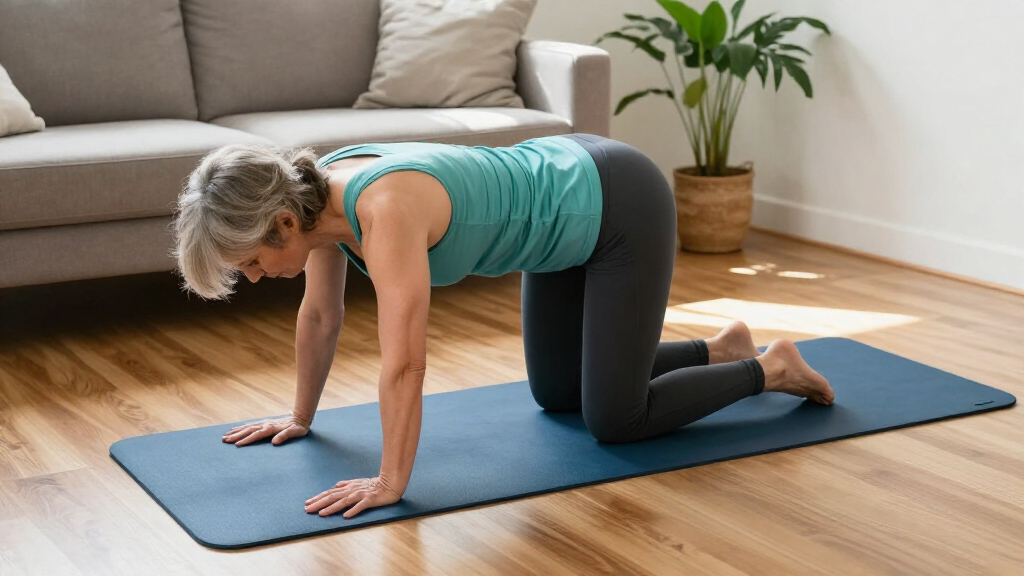
The dead bug alternates an extended arm and opposite leg while the lower back remains in contact with the floor. The glute bridge raises the hips until the body forms a line from shoulders to knees, without over-arching the lower back. In the bird dog, participants extend opposite arm and leg from hands and knees while keeping the hips level. The sequence ends with a child’s pose and deep breathing.
A Short Routine With Built-In Options
The routine gives beginners a defined sequence and time commitment instead of requiring them to assemble exercises themselves. Its modifications also make parts of the workout easier to scale: for example, the hundred can be done with the head down and feet on the floor. That guidance may help newcomers adapt the movement to their current ability, although the article does not claim the routine is suitable for every person.
Griffiths says the exercises engage the core and muscles that help stabilize the spine, while the bridge and bird dog also work the glutes and muscles supporting the back. These are the instructor’s explanations of the workout’s intended focus, not reported findings from a clinical trial. The piece presents Pilates as a way to practise controlled movement and body awareness alongside strength work.
The schedule is also specific: three sessions a week, with a day off between sessions. That offers a practical starting point for readers considering a regular home routine, while leaving room for recovery. The source does not provide research data showing what results an individual should expect or how quickly they may occur.
Products Worth Considering

Therabody Theragun Relief Massage Gun, 3-Speed, Navy

Fitbit Charge 6 Activity Tracker – Obsidian/Black

Levoit Vital 100S-P Air Purifier with Washable Pre-Filter
As an affiliate, we earn on qualifying purchases.
The Six Exercises and Their Sequence
The workout starts with one set of 8–10 pelvic tilts, followed by one set of the hundred. The source lists 40 pulses for the beginner version and a 30-second rest. It describes 100 pulses as a longer-term target, rather than a requirement for someone starting out.
Next are two sets of 8–10 dead bugs per side, with a 30-second rest, and two sets of 10–12 glute bridges, also with a 30-second rest. The bird dog is prescribed for two sets of 8–10 repetitions per side, with another 30-second rest. A 30-to-60-second child’s pose completes the sequence. The source does not specify how much time to allocate for transitions or rests beyond those listed.
Griffiths advises progressing the programme when it begins to feel easy, but the report does not lay out a detailed progression plan. His coaching cues emphasize control: keep the lower back connected to the floor during the dead bug and imagine a glass of water balanced on the lower back during the bird dog.
“Small and controlled is the aim. The movement comes from the pelvis, not the legs.”
— Andrew Griffiths, Pilates instructor and fitness expert at Net World Sports, as quoted by Fit&Well
Results and Suitability Remain Unspecified
The report does not provide trial data, measurements or a time frame for how much strength or stability a participant might gain. Its statements about posture, back support and stress are attributed to Griffiths and are not presented with study results in the source material. Individual outcomes may vary.
It is also unclear whether the routine has been assessed for people with injuries, ongoing pain, pregnancy or other health considerations. The article offers exercise instructions and some modifications, but does not set out individualized guidance or screening criteria. Readers unsure whether these movements are appropriate for them can seek advice from a qualified health professional.
Although the routine is described as 10 minutes, actual completion time may differ depending on rest periods, movement pace and breaks. The source does not specify whether the suggested sets and repetitions are intended to fit that time exactly.
Repeat, Recover and Adjust
Griffiths recommends repeating the workout three times weekly and taking a day off between sessions. Participants can start with the easier versions and listed beginner targets, then consider progressing when the routine feels easy, as the source advises. It does not specify a fixed number of weeks, a required increase in repetitions or a follow-up programme.
The next practical step for a reader interested in trying the routine is to review each movement’s setup and keep the emphasis on controlled motion. The report gives no announced follow-up study or further development; any assessment of results would depend on an individual’s experience over time.
Key Questions
What exercises are in the 10-minute Pilates workout?
The six movements are pelvic tilt, the hundred, dead bug, glute bridge, bird dog and child’s pose. The source gives sets, repetitions or hold times for each.
Does the routine require equipment?
No equipment is listed. Fit&Well says participants need space on the floor to do the exercises.
How often does the instructor recommend doing it?
Andrew Griffiths recommends three sessions a week with a day off between sessions. This is his suggested schedule in the report, not a guarantee of results.
Can beginners modify the exercises?
Yes. For the hundred, the source says beginners can keep their head and shoulders on the floor and keep their feet on the ground. Griffiths also suggests starting with 40 or 50 pulses if 100 feels too challenging.
Does the report say how quickly the workout will build strength?
No. It gives no quantified results or time frame. Griffiths describes the routine’s intended focus, but the source does not report a study measuring outcomes.
Source: rss