The best carving knives for older adults balance a secure, comfortable grip with a blade that slices cleanly without demanding extra force. My best overall pick is the Mercer Culinary Genesis 10-Inch Forged Carving Knife for its forged construction and versatile length; the HENCKELS Graphite 8-Inch is a more compact choice, while the Wüsthof Gourmet 2-Piece Set suits cooks who want a matching carving fork. The main tradeoff is reach versus control: longer blades handle large roasts well but can feel unwieldy, while shorter blades are easier to maneuver but may need more strokes. Grip texture, balance, storage, and cleaning also matter, especially when hand strength or dexterity is a concern. Read on for how all nine options compare and which one best fits your kitchen.

Turn quiet afternoons into listening time
- Thousands of audiobooks, podcasts and originals
- Listen on your phone, tablet or Echo — also offline
- Cancel anytime
Complete the kit


Key Takeaways
- Blade length shapes the experience: The 10-inch Mercer models offer useful reach for roasts, while the 8-inch HENCKELS knives are easier to manage for smaller cuts and tighter work areas.
- A full set is not automatically the most comfortable choice: The Cangshan and Wüsthof sets add a carving fork, but buyers who prefer fewer tools may be better served by a single knife.
- Handle security deserves as much attention as sharpness: Textured or shaped grips can help with control, but handle material and fit still need to suit the user’s hand and grip strength.
- The longest blade has a narrower use case: The 12-inch Cutluxe is suited to brisket and large roasts, but its extra reach can be harder to steer than an 8- or 10-inch blade.
- The compact MATTSTONE HILL and curved Huusk serve different jobs: The 5-inch utility knife favors small tasks, while the curved 10-inch Huusk is less conventional for straightforward roast slicing.
| MATTSTONE HILL 5-Inch Kitchen Utility Knife with Rosewood Handle |  | Best Compact Option | Blade length: 5 inches | Overall length: 9.8 inches | Blade material: X30Cr13 stainless steel | VIEW LATEST PRICE | See Our Full Breakdown |
| HENCKELS Graphite 8-Inch Carving Knife |  | Best for Easy Cleanup | Blade length: 8 inches | Blade material: Stainless steel | Blade finish: Satin-finished | VIEW LATEST PRICE | See Our Full Breakdown |
| Cangshan Sanford Series 2-Piece German Steel Carving Set |  | Best Complete Carving Set | Set includes: 9-inch carving knife with sheath; 6-inch carving fork | Blade length: 9 inches | Blade material: High-alloy German steel | VIEW LATEST PRICE | See Our Full Breakdown |
| Wüsthof Gourmet 2-Piece Carving Knife Set, Black |  | Best for Familiar, Soft-Grip Handling | Set contents: 8-inch carving knife and 6-inch meat fork | Blade material: High-carbon stainless steel | Blade edge: Plain | VIEW LATEST PRICE | See Our Full Breakdown |
| Mercer Culinary Genesis 10-Inch Forged Carving Knife |  | Best for Large Roasts | Blade length: 10 inches | Blade material: High-carbon German steel | Blade edge: Plain, taper-ground | VIEW LATEST PRICE | See Our Full Breakdown |
| Mercer Culinary Renaissance 10-Inch Carving Knife |  | Best Overall for a Balanced, Full-Length Grip | Blade length: 10 inches | Blade material: High-carbon German cutlery steel | Construction: Forged | VIEW LATEST PRICE | See Our Full Breakdown |
| Cutluxe 12-Inch Brisket and Carving Knife |  | Best for Large Roasts and Long, Clean Slices | Blade length: 12 inches | Blade material: High-carbon German stainless steel (1.4116 / X50CrMoV15) | Edge: Hollow Granton | VIEW LATEST PRICE | See Our Full Breakdown |
| Huusk 10-Inch Japanese-Style Curved Butcher Knife with Wood Handle |  | Best for a Curved Cutting Style | Blade length: 10 inches | Overall length: 15 inches | Blade material: ATS-34 steel | VIEW LATEST PRICE | See Our Full Breakdown |
| HENCKELS Solution 8-Inch Carving Knife |  | Best for Lightweight Handling and Easy Cleanup | Blade length: 8 inches | Blade material: Stainless steel | Construction: Precision-stamped, single-piece blade | VIEW LATEST PRICE | See Our Full Breakdown |
| carving knives for older adult | Blade material | Blade length | Construction | Blade edge |
|---|---|---|---|---|
| MATTSTONE HILL 5-Inch Kitchen | X30Cr13 stainless steel | 5 inches | Stamped | Plain |
| HENCKELS Graphite 8-Inch Carvi | Stainless steel | 8 inches | Fully forged bolster | Half-serrated |
| Cangshan Sanford Series 2-Piec | High-alloy German steel | 9 inches | Forged | Plain |
| Wüsthof Gourmet 2-Piece Carvin | High-carbon stainless steel | — | Stamped | Plain |
| Mercer Culinary Genesis 10-Inc | High-carbon German steel | 10 inches | Forged | Plain, taper-ground |
| Mercer Culinary Renaissance 10 | High-carbon German cutlery steel | 10 inches | Forged | Plain |
| Cutluxe 12-Inch Brisket and Ca | High-carbon German stainless steel (1.4116 / X50CrMoV15) | 12 inches | Forged, full tang | — |
| Huusk 10-Inch Japanese-Style C | ATS-34 steel | 10 inches | — | — |
| HENCKELS Solution 8-Inch Carvi | Stainless steel | 8 inches | Precision-stamped, single-piece blade | — |
More Details on Our Top Picks
MATTSTONE HILL 5-Inch Kitchen Utility Knife with Rosewood Handle
For an older adult who wants a smaller, lighter knife for everyday slicing rather than a full roast, this 5-inch utility blade is the most manageable option in this group. At 3.04 ounces, it is much lighter than the HENCKELS Graphite carving knife, and the rosewood handle has a hand stop intended to support a secure grip. Its plain X30Cr13 stainless steel edge is described as easy to maintain, and the short blade can handle smaller portions of meat, cheese, fruit, and vegetables without the reach of a long carving knife.
The tradeoff is capacity: it is not a dedicated roast-carving knife, and the 5-inch blade can feel restrictive on large poultry or roasts. Its stamped construction also differs from the forged Mercer Culinary Genesis. Choose it for lighter, compact kitchen tasks; skip it if your main goal is carving large cuts at the table.
Pros:- Light 3.04-ounce weight may be easier to handle than the longer carving knives here.
- Rosewood handle includes a hand stop designed to support a secure grip.
- Plain X30Cr13 stainless steel blade is described as easy to maintain.
- Versatile for smaller portions of meat, sausage, cheese, fruit, and vegetables.
Cons:- Five-inch blade is limiting for large roasts and whole poultry.
- Stamped construction may be less appealing to buyers seeking a forged knife.
- Utility-knife format is not a substitute for a full-size carving knife.
Best for: Older adults who prefer a lightweight, short knife for slicing smaller portions of meat, cheese, and produce.
Not ideal for: People who regularly carve large roasts or whole poultry and need a long blade with broad slicing strokes.
- Blade length:5 inches
- Overall length:9.8 inches
- Blade material:X30Cr13 stainless steel
- Handle material:Rosewood
- Construction:Stamped
- Blade edge:Plain
- Item weight:3.04 ounces
Our verdict“Choose this compact, lightweight knife for everyday small-scale slicing, not for carving large roasts.”
HENCKELS Graphite 8-Inch Carving Knife
The HENCKELS Graphite is a practical pick for older adults who value dishwasher-safe cleanup and a moderate blade length over a traditional all-purpose carving edge. Its 8-inch half-serrated blade is shorter than the 9-inch Cangshan Sanford knife and the 10-inch Mercer Genesis, which can make it less unwieldy for smaller serving boards or users who prefer shorter strokes. The fully forged bolster is designed to add balance and durability, while the ergonomic handle is intended to reduce strain during cutting.
Its main compromise is the half-serrated edge: that can suit some slicing jobs but may feel less familiar to people who want a fully plain blade for smooth, controlled carving. The stainless steel handle may also feel colder or less forgiving than the Santoprene grip on the Mercer. It makes sense for convenient cleanup, but not for buyers who prioritize a soft-feeling handle or a long blade for broad roast slices.
Pros:- Dishwasher-safe care can reduce cleanup effort.
- Eight-inch blade is shorter than the Cangshan Sanford and Mercer Genesis carving knives.
- Fully forged bolster is designed to support balance and durability.
- Ergonomic handle is intended for comfortable cutting.
Cons:- Half-serrated edge may not suit users who prefer a plain carving blade.
- Stainless steel handle may feel less comfortable than a nonmetal grip.
- Shorter blade offers less reach for large roasts than the Mercer Genesis.
Best for: Older adults who want an 8-inch carving knife with dishwasher-safe care and a shorter reach than longer roast knives.
Not ideal for: Users who prefer a fully plain blade, a softer nonmetal handle, or a longer blade for large roasts.
- Blade length:8 inches
- Blade material:Stainless steel
- Blade finish:Satin-finished
- Blade edge:Half-serrated
- Construction:Fully forged bolster
- Handle material:Stainless steel
- Item weight:8 ounces
- Care:Dishwasher safe
Our verdict“Pick the HENCKELS Graphite if convenient dishwasher cleanup and a moderate blade length matter more than a plain edge or soft-grip handle.”
Cangshan Sanford Series 2-Piece German Steel Carving Set
The Cangshan Sanford is the most complete choice here for someone who wants a knife and matching carving fork rather than assembling tools separately. Its 9-inch plain-edge knife sits between the 8-inch HENCKELS Graphite and the 10-inch Mercer Genesis in reach, offering room for roast slices without the longest blade in the lineup. Forged high-alloy German steel, hand sharpening, and ULTRA6 heat treatment are intended to support edge sharpness and retention, while the included sheath gives the knife a safer storage option.
For older adults, the set’s secure-grip handle design and included fork can make carving and serving feel more controlled. The tradeoff is that a fork adds another tool to handle and store, and the product information does not give a weight that would help buyers judge heft. Compared with the simpler Wüsthof set, this one has a longer knife and sheath, but it may be more than needed for occasional small meals.
Pros:- Includes a 9-inch carving knife, 6-inch carving fork, and knife sheath.
- Forged high-alloy German steel is described as durable and stain resistant.
- Hand-sharpened plain edge and ULTRA6 heat treatment are designed to support sharpness and edge retention.
- Ergonomic handles are designed for a comfortable, secure grip.
Cons:- The fork adds handling and storage needs for buyers who only want a knife.
- Steel handle may not suit users who prefer a softer-feeling grip.
- The available product data does not specify the set’s weight.
Best for: Older adults who regularly serve roasts or poultry and want a carving knife, fork, and sheath in one set.
Not ideal for: People who carve only small portions, want a single lightweight knife, or prefer a nonmetal handle.
- Set includes:9-inch carving knife with sheath; 6-inch carving fork
- Blade length:9 inches
- Blade material:High-alloy German steel
- Construction:Forged
- Blade edge:Plain
- Handle material:Steel
- Certification:NSF Certified
- Warranty:Limited lifetime
Our verdict“Choose the Cangshan set for regular roast carving when a fork and sheath are as useful as the knife itself.”
Wüsthof Gourmet 2-Piece Carving Knife Set, Black
Older adults who dislike the feel of metal handles may find the Wüsthof Gourmet set more approachable than the Cangshan Sanford, which has steel handles. Its triple-riveted polypropylene handles provide a nonmetal grip, and the set pairs an 8-inch plain-edge knife with a 6-inch meat fork for carving and serving. The shorter blade is easier to manage than the 10-inch Mercer Genesis, though it gives up some reach on large roasts. High-carbon stainless steel is designed for sharpness and straightforward maintenance.
This is a sensible serving set, but its hand-wash-only care asks more of the owner than the dishwasher-safe HENCKELS Graphite. The stamped construction also sets it apart from the forged Cangshan and Mercer options, a tradeoff for buyers who prefer a less premium build. It suits people who want a conventional, nonmetal handle and a matching fork; skip it if avoiding sink cleanup is a priority.
Pros:- Polypropylene handle offers a nonmetal grip and is designed to resist fading, discoloration, heat, and impact.
- Includes an 8-inch carving knife and 6-inch meat fork.
- Plain high-carbon stainless steel blade is designed for sharpness and easy maintenance.
- Shorter blade may be easier to manage than the 9-inch Cangshan or 10-inch Mercer.
Cons:- Hand washing is required, unlike the dishwasher-safe HENCKELS Graphite.
- Stamped construction may not satisfy buyers seeking a forged knife.
- Eight-inch blade provides less reach than the Mercer Genesis for large roasts.
Best for: Older adults who want a shorter plain-edge carving knife, a nonmetal handle, and a matching meat fork.
Not ideal for: People who need dishwasher-safe cleanup, a forged construction, or extra blade reach for large cuts.
- Set contents:8-inch carving knife and 6-inch meat fork
- Blade material:High-carbon stainless steel
- Blade edge:Plain
- Construction:Stamped
- Handle material:Polypropylene
- Handle construction:Triple-riveted
- Item weight:8.8 ounces
- Care instructions:Hand wash only
Our verdict“Choose this set if a familiar nonmetal handle and included fork matter more than dishwasher-safe care or forged construction.”
Mercer Culinary Genesis 10-Inch Forged Carving Knife
For an older adult who regularly carves large roasts, poultry, or sizable produce, the Mercer Genesis offers the most reach among the single knives in this group. Its 10-inch plain, taper-ground blade is longer than the 8-inch HENCKELS Graphite and Wüsthof knives, so it can make broader slicing strokes across large foods. The forged high-carbon German steel blade is paired with an ergonomic non-slip Santoprene handle, a useful contrast with the metal-handled HENCKELS and Cangshan models for buyers who want a grippier-feeling handle.
That reach comes with a handling tradeoff: a 10-inch blade may feel unwieldy to someone with limited hand strength or a small cutting board. It also requires hand washing and thorough drying, unlike the dishwasher-safe HENCKELS. This is the strongest fit for frequent large-cut carving, but occasional carvers who want a shorter, easier-to-store knife may prefer the Wüsthof set.
Pros:- Ten-inch blade offers reach for large roasts, poultry, and sizeable produce.
- Non-slip Santoprene handle is designed to remain secure, including when wet.
- Forged high-carbon German steel blade has a plain, taper-ground edge.
- Lifetime limited manufacturer’s warranty.
Cons:- Long blade may be harder to control or store than the 8-inch HENCKELS Graphite or Wüsthof knife.
- Hand washing and thorough drying are required.
- Should not be submerged for long periods.
Best for: Older adults who often carve large roasts or poultry and want a long blade paired with a non-slip handle.
Not ideal for: People with limited reach, small cutting boards, or a preference for dishwasher-safe cleanup and compact storage.
- Blade length:10 inches
- Blade material:High-carbon German steel
- Blade edge:Plain, taper-ground
- Construction:Forged
- Handle material:Santoprene
- Item weight:8.4 ounces
- Care instructions:Hand wash with warm water and mild soap; rinse and dry completely
- Warranty:Lifetime limited manufacturer’s warranty
Our verdict“Choose the Mercer Genesis for frequent large-cut carving if you can comfortably manage a 10-inch blade and hand-wash it.”
Mercer Culinary Renaissance 10-Inch Carving Knife
The Mercer Culinary Renaissance earns my best-overall spot for older adults who want a standard-length carving blade without the extra reach of a 12-inch knife. Its 10-inch forged German-steel blade suits roasts and larger produce, while the lightweight 0.19 kg build can be easier to guide than the longer Cutluxe. A rounded spine and triple-riveted ergonomic handle are practical comfort features for cooks who value a less abrupt hand contact during longer slicing sessions. Compared with the shorter HENCKELS Solution, this Mercer offers more blade length for broad cuts, but it takes more room to handle and store. The main compromise is upkeep: it must be hand-washed, rinsed, and dried promptly, so it is a weaker fit for anyone who relies on dishwasher cleanup.
Pros:- 10-inch forged blade provides useful reach for carving roasts and cutting larger produce.
- Lightweight 0.19 kg construction may be easier to guide than the 12-inch Cutluxe.
- Rounded spine and triple-riveted ergonomic handle offer grip-comfort features.
- High-carbon German cutlery steel and a lifetime limited manufacturer’s warranty.
Cons:- Hand washing and thorough drying add cleanup steps.
- The 10-inch blade is less compact than the 8-inch HENCKELS Solution for smaller meals and tight storage.
Best for: Older adults who regularly carve roasts and want a lightweight, 10-inch forged knife with a comfort-oriented spine and handle.
Not ideal for: Cooks with limited sink or storage space, or anyone who needs a dishwasher-safe knife and low-effort cleanup.
- Blade length:10 inches
- Blade material:High-carbon German cutlery steel
- Construction:Forged
- Blade edge:Plain
- Handle:Delrin and Santoprene; triple-riveted ergonomic design
- Weight:0.19 kg
- Care:Hand wash, rinse, and dry thoroughly; do not use dishwasher
- Warranty:Lifetime limited manufacturer’s warranty
Our verdict“Choose the Mercer for a light, full-length carving knife with comfort-minded details, provided hand-washing is acceptable.”
Cutluxe 12-Inch Brisket and Carving Knife
For older adults who frequently serve brisket or large roasts, the 12-inch Cutluxe offers more uninterrupted cutting length than the Mercer Renaissance or the 8-inch HENCKELS Solution. Its Granton edge is designed to help food release from the blade, which can make repeated slices less sticky, while the full-tang build and triple-riveted Pakkawood handle give the knife a substantial grip. That size is also its central tradeoff: the long blade needs more room to maneuver, wash, and store, and may feel harder to control for someone with limited reach or hand strength. The included sheath helps protect the edge in storage, but the handle and sharp blade still call for careful maintenance. I’d pick it for large-meat carving, not as the easiest all-purpose option.
Pros:- 12-inch blade allows long slicing strokes across large cuts of meat.
- Granton edge is designed to reduce food sticking to the blade.
- Full-tang forged construction and triple-riveted Pakkawood handle provide a stable grip.
- Includes a storage sheath and a lifetime warranty against material or workmanship defects.
Cons:- The long blade can be awkward to control, wash, and store in a small kitchen.
- Pakkawood and the sharp edge require attentive care.
- Less versatile for smaller servings and precise tasks than the 10-inch Mercer Renaissance.
Best for: Older adults who regularly carve brisket, ribs, or large roasts and have the reach, grip, and storage space for a 12-inch blade.
Not ideal for: Cooks with reduced hand strength, limited counter or drawer space, or a preference for a shorter, easier-to-maneuver knife.
- Blade length:12 inches
- Blade material:High-carbon German stainless steel (1.4116 / X50CrMoV15)
- Edge:Hollow Granton
- Construction:Forged, full tang
- Edge angle:14–16 degrees per side
- Hardness:56+ Rockwell
- Handle and weight:Triple-riveted Pakkawood; 9.6 ounces
- Included and warranty:Sheath; lifetime warranty against material or workmanship defects
Our verdict“Choose the Cutluxe for frequent carving of large roasts if its extra length feels manageable in your hands and kitchen.”
Huusk 10-Inch Japanese-Style Curved Butcher Knife with Wood Handle
The Huusk 10-inch curved knife is the most distinctive option here for cooks who prefer a rocking or sweeping motion rather than the straighter slicing style encouraged by the Mercer Renaissance. Its textured blade surface is designed to limit food sticking, and the 12-degree edge angle points toward a fine, keen cut. The shaped, three-rivet wood handle is intended to support a secure grip, though the product details do not give a weight, so I can’t compare its heft with the 5.6-ounce HENCKELS Solution. I’d also be cautious about the conflicting hardness claims—58–60 HRC and 63+ HRC—which make the steel specification less clear than those on the Cutluxe. Its 10-inch length may still feel unwieldy for small tasks or limited hand control.
Pros:- Curved 10-inch blade supports a sweeping cutting motion.
- Textured surface is designed to help reduce food sticking.
- Three-rivet wood handle is shaped for a secure grip.
- Forged ATS-34 blade and a stated 12-degree cutting edge angle.
Cons:- Blade hardness is reported inconsistently as both 58–60 HRC and 63+ HRC.
- The 10-inch blade may be cumbersome for small portions or precise, short cuts.
- No product weight is provided, making it harder to judge handling effort against the lightweight HENCKELS Solution.
Best for: Older adults who already prefer a curved, sweeping cut and want a 10-inch knife for carving several kinds of food.
Not ideal for: Buyers who want clear, consistent steel specifications, a compact knife, or an explicitly lightweight option for easier control.
- Blade length:10 inches
- Overall length:15 inches
- Blade material:ATS-34 steel
- Construction and edge:Forged; plain edge
- Stated hardness:Conflicting claims: 58–60 HRC and 63+ HRC
- Cutting edge angle:12 degrees
- Handle:Wood with three-rivet construction
- Blade surface:Textured surface designed to reduce food sticking
Our verdict“Consider the Huusk if a curved slicing motion suits your grip, but skip it if you want dependable, unambiguous steel specifications.”
HENCKELS Solution 8-Inch Carving Knife
Among these four, the HENCKELS Solution is the most approachable choice for older adults who prioritize low weight and everyday cleanup over maximum carving reach. At 5.6 ounces with an 8-inch blade, it is more compact to maneuver than the Cutluxe 12-inch and can be easier to store or use for modest roasts. Its precision-stamped stainless-steel blade is finely honed, and the knife is listed as dishwasher safe—a practical difference from the hand-wash-only Mercer Renaissance. The shorter blade is also the tradeoff: it may need more strokes across a large roast and is less suited to broad, uninterrupted slices. The plastic handle may not appeal to buyers who prefer the wood or Pakkawood feel of the Huusk and Cutluxe, though the triple-rivet design is intended for controlled handling.
Pros:- Light 5.6-ounce build supports easier maneuvering than the longer Cutluxe.
- 8-inch blade is compact to handle and store.
- Dishwasher-safe stainless steel offers simpler cleanup than the hand-wash-only Mercer Renaissance.
- Ergonomic triple-rivet handle is designed for a controlled grip.
Cons:- Shorter blade is less suited to long slices through large roasts.
- Plastic handle may feel less appealing than the wood handle on the Huusk or Pakkawood on the Cutluxe.
- Precision-stamped construction differs from the forged construction of the Mercer Renaissance.
Best for: Older adults who want a light, compact carving knife for smaller roasts and value dishwasher-safe cleanup.
Not ideal for: People who often carve very large roasts and want a longer blade for extended, uninterrupted slices.
- Blade length:8 inches
- Blade material:Stainless steel
- Construction:Precision-stamped, single-piece blade
- Blade edge and finish:Plain edge; satin finish
- Weight:5.6 ounces
- Handle:Ergonomic, triple-rivet plastic handle
- Care:Dishwasher safe or hand wash
- Warranty:Lifetime warranty against manufacturer’s defects
Our verdict“Choose the HENCKELS Solution if light handling and easy cleanup matter more than having a long blade for large roasts.”
How We Picked
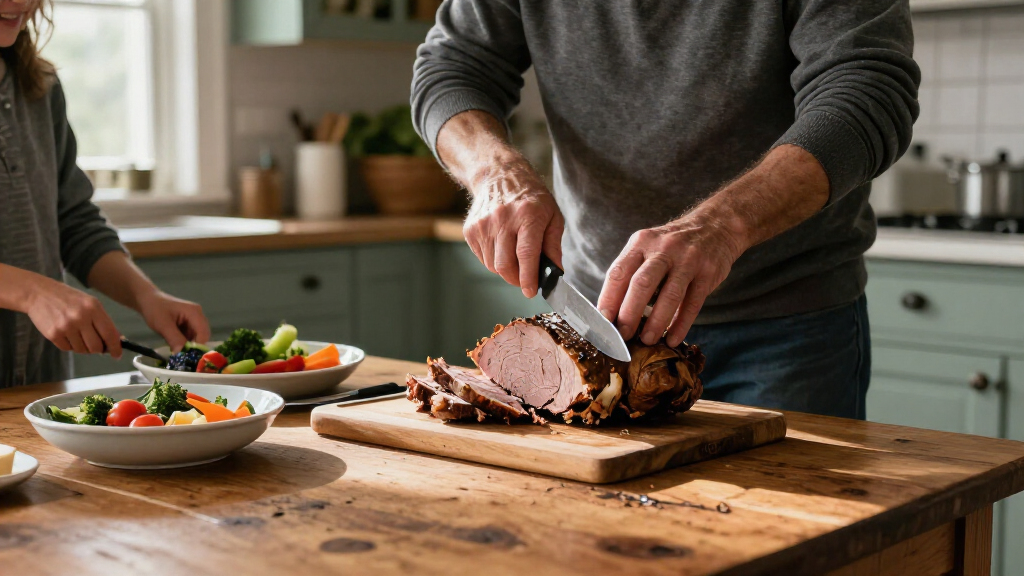
I compared these nine knives through the needs that often matter most to older adults: a grip that feels secure, a manageable blade length, predictable control, and a design suited to the food being sliced. I also weighed construction, the usefulness of included accessories, versatility beyond holiday roasts, and the likely demands of cleaning, sharpening, and storage. A knife’s listed features cannot establish how it will feel in every hand, so I treat grip comfort as a personal fit rather than a universal claim.
The ranking favors knives with a practical balance of reach, control, and everyday usefulness. The Mercer Genesis earns the lead for its forged 10-inch format; the shorter HENCKELS options rank well for buyers who value maneuverability. Sets place higher for cooks who will use a fork, while the long Cutluxe and curved Huusk are more specialized. The MATTSTONE HILL utility knife is included for compact tasks, but its short blade makes it a limited stand-in for a dedicated carving knife.
| carving knives for older adult | Handle material | Construction | Blade edge |
|---|---|---|---|
| MATTSTONE HILL 5-Inch Kitchen | Rosewood | Stamped | Plain |
| HENCKELS Graphite 8-Inch Carvi | Stainless steel | Fully forged bolster | Half-serrated |
| Cangshan Sanford Series 2-Piec | Steel | Forged | Plain |
| Wüsthof Gourmet 2-Piece Carvin | Polypropylene | Stamped | Plain |
| Mercer Culinary Genesis 10-Inc | Santoprene | Forged | Plain, taper-ground |
| Mercer Culinary Renaissance 10 | — | Forged | Plain |
| Cutluxe 12-Inch Brisket and Ca | — | Forged, full tang | — |
| Huusk 10-Inch Japanese-Style C | — | — | — |
| HENCKELS Solution 8-Inch Carvi | — | Precision-stamped, single-piece blade | — |
Factors to Consider When Choosing Carving Knives For Older Adults
Choosing a carving knife for an older adult is less about finding the longest or most elaborate blade and more about matching the tool to the person’s grip, usual meals, and kitchen routine. These broader checks can help narrow the field before committing to a knife or set.
Match Blade Length to the Food and the User
A blade should be long enough to slice across the roast in a controlled stroke, but longer is not automatically easier. For a small chicken or occasional serving tasks, a shorter blade may feel less cumbersome and require less space at the cutting board. Large turkey breasts, brisket, and wide roasts benefit from greater reach, though a long blade can be harder to guide if the user has limited wrist strength. A common mistake is choosing the longest knife for its apparent versatility without considering where it will be stored or how it will be handled. Think about the largest food regularly carved, not the biggest meal served once a year. If the knife feels awkward to lift or turn, a shorter model is often the more practical choice.
Prioritize a Grip That Stays Secure
Handle shape and surface affect confidence when slicing, particularly if hands become tired or grip strength varies. A handle should feel stable without requiring a tight squeeze, and the user should be able to hold it with a relaxed wrist. Smooth wood may appeal for its warmth and appearance, but it can need more attentive care and may feel less secure when damp. Textured or contoured materials can offer a different kind of purchase, though no material is comfortable for every hand. If possible, compare handle thickness and balance in person rather than relying on product images. Avoid assuming that a heavier handle or a prominent bolster will automatically improve control.
Choose a Knife or Set Based on Actual Use
A carving fork can steady meat while the knife slices, but it adds another tool to hold, wash, and store. Buyers who already use a fork they like may gain little from a bundled set. On the other hand, someone who regularly carves large roasts may appreciate having a matched fork close at hand. Consider whether handling two utensils at once feels comfortable and whether the extra tool has a dedicated storage spot. Single knives keep the purchase and routine simpler, while sets make sense when both pieces will see regular use. Do not let the presence of an accessory outweigh the fit of the knife itself.
Weigh Balance and Weight Against Fatigue
Neither the lightest nor the heaviest knife is the right choice for everyone. A well-balanced knife can feel steady during a slicing stroke, while a blade that feels front-heavy may tire the wrist or make fine control harder. Very light models can be easier to lift but may call for more deliberate pressure through dense meat. Hand strength, joint comfort, and how long a typical carving task lasts all affect this tradeoff. When comparing options, pay attention to whether the handle and blade feel like one controllable tool rather than separate weights. Buyers should also avoid equating forged construction with comfort; construction describes how a knife is made, not how it fits a particular user.
Plan for Sharpening, Washing, and Safe Storage
A sharp knife generally needs less force than a dull one, so maintenance has a direct bearing on comfort and control. Before choosing, check whether the user can maintain the edge independently or has access to a sharpening service. Hand-washing and careful drying may be preferable for some knife materials, while a dishwasher can expose handles and edges to unnecessary wear. Safe storage matters too: a long blade left loose in a drawer is harder to handle safely than one kept in a sheath, block, or secure organizer. If reaching into a crowded drawer is difficult, favor a storage plan that keeps the blade visible and easy to retrieve. A knife that is simple to care for is more likely to remain useful over time.
Treat Specialty Shapes as Purpose-Built Tools
Carving knives can look similar while behaving quite differently on the board. A straight carving blade suits familiar slices of poultry and roasts, while an unusually long or curved blade may fit particular cuts better than general household use. Buyers sometimes choose a distinctive profile for its appearance without checking whether it matches the meals they prepare. Consider the user’s regular cutting tasks and comfort with steering a blade before prioritizing a specialty shape. For a primary kitchen knife, a conventional design is usually easier to put to varied use. A specialized blade makes more sense as an additional tool than as the only carving option when its intended use is narrow.
Frequently Asked Questions
Is an 8-inch or 10-inch carving knife easier for an older adult to control?
Neither length is universally easier; the best fit depends on hand strength, cutting space, and the size of the food. An 8-inch blade is often simpler to maneuver around smaller roasts and takes up less room on the board. A 10-inch blade can cover more distance per stroke, which may help with larger cuts, but it can feel harder to steer. If the user has limited wrist mobility or prefers compact tools, start by comparing shorter blades. Choose a longer blade only if its reach solves a regular task and its weight feels manageable.
Should I buy a carving knife set with a fork or just the knife?
Choose a set if the user regularly carves large roasts and is comfortable coordinating a knife and fork. A fork can steady meat, but it also adds another item to grip, clean, and store. If the user already has a preferred serving fork or tends to carve smaller portions, a single knife may be simpler. The knife’s handle and balance should take priority over the included accessory. A set is useful when both pieces match the user’s routine, not just because the pieces are sold together.
What handle features matter most if grip strength is limited?
Look for a handle that feels secure without demanding a tight grasp, and pay attention to its thickness, shape, and surface. A gently contoured or textured handle may be easier to keep steady than a very slim, slick one, but personal fit varies. Balance matters as well: a handle that feels comfortable can still be tiring if the blade pulls the wrist forward. If shopping in person, have the user hold the knife in a relaxed grip and mimic a slicing motion without cutting. If shopping online, check dimensions and return terms rather than relying on broad claims about comfort.
Is a 12-inch carving knife a good choice as the only carving knife?
A 12-inch knife can be useful for brisket and large roasts, but it may be excessive for a small kitchen or everyday poultry carving. Its length calls for more room to maneuver and a safe place to store the blade. A user who has reduced wrist strength or limited counter space may find a shorter model easier to control. If large cuts are common, the extra reach can be worthwhile; if they are occasional, a 8- or 10-inch knife is usually more versatile. Match the blade to routine meals rather than rare occasions.
Can a compact utility knife replace a dedicated carving knife?
A compact utility knife can handle small servings and general kitchen tasks, but it is not a full substitute for carving a large roast. Its shorter blade may require several strokes across wide meat, which can make neat, even slices harder to achieve. The MATTSTONE HILL’s 5-inch format fits compact tasks better than broad carving work. If the user only portions small pieces, a utility knife may cover enough of the need. For regular holiday roasts or brisket, a dedicated longer carving knife is the more practical tool.
Conclusion
For the broadest mix of reach and everyday carving use, I recommend the Mercer Culinary Genesis 10-Inch as the best overall pick. Buyers seeking a potentially more manageable blade should compare the HENCKELS Graphite 8-Inch and HENCKELS Solution 8-Inch; the latter is the best value choice in this lineup, while the Graphite is the stronger fit for those drawn to its distinct design. For a premium set-oriented choice, I would look at the Wüsthof Gourmet 2-Piece Set, especially if the carving fork will be used. Beginners who want a straightforward single knife can start with the Mercer Culinary Renaissance 10-Inch, while cooks focused on brisket and large roasts may prefer the extra reach of the Cutluxe 12-Inch. Choose the MATTSTONE HILL for compact utility tasks, not as a primary roast slicer, and reserve the curved Huusk for buyers who specifically want that blade shape. The best choice is the one the user can grip securely, guide comfortably, and maintain safely.