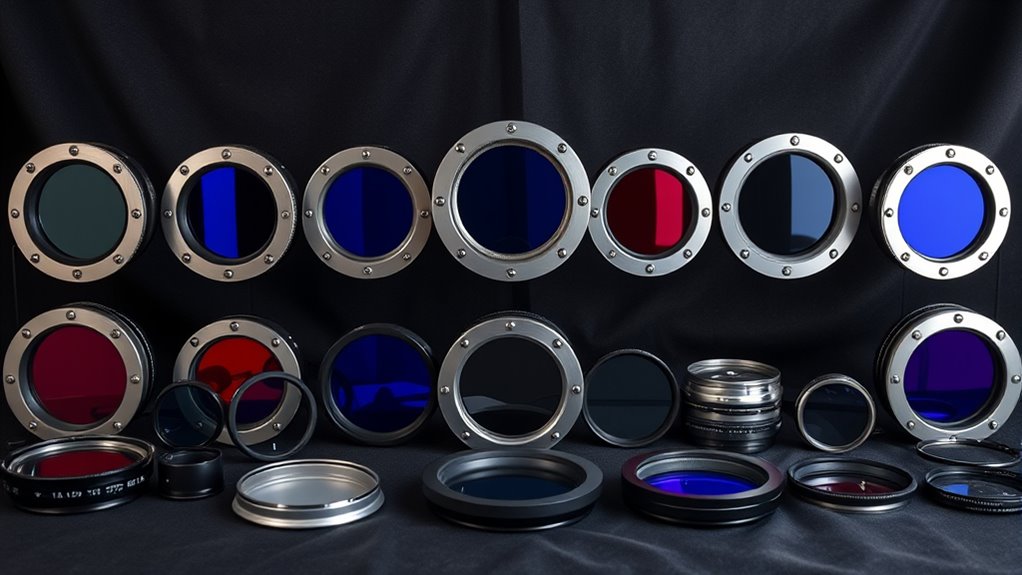

Color imaging with a monochrome camera comes down to two purchases: a way to hold your filters and the filters themselves. That pairing is exactly what this comparison covers. My top picks are the Astromania 1.25″ Manual Filter Wheel, the best entry point for anyone who wants quick filter changes without buying motorized hardware, and the Alstar 2″ Deluxe LRGB Filter Kit, a complete four-filter set that turns a mono CCD or CMOS camera into a full-color imaging machine. The two products solve different halves of the same problem, and many buyers will genuinely need both — but the order you buy them in, and the size you standardize on, is where the real decision lives.

Turn quiet afternoons into listening time
- Thousands of audiobooks, podcasts and originals
- Listen on your phone, tablet or Echo — also offline
- Cancel anytime
The main tradeoff in this category is aperture versus convenience. A 1.25″ wheel like the Astromania keeps costs and bulk low, but it vignettes on larger sensors and limits you to smaller filters. A 2″ LRGB set like the Alstar future-proofs you for full-frame mono sensors but demands a 2″ wheel (sold separately) and a bigger budget. Manual versus motorized operation is the second axis: manual wheels cost a fraction of motorized ones but require touching the scope between exposures, which means re-centering and, on some setups, refocusing. I walk through both tradeoffs below so you can match the hardware to your camera, telescope, and patience level.
Complete the kit


Key Takeaways
- The Astromania wheel and Alstar LRGB set are complementary, not competing: one holds filters, the other supplies them, and a full mono color rig often needs both.
- The Astromania’s 23mm inward back focus requirement is its biggest constraint — Newtonian owners should verify focus travel before buying.
- The Alstar filters are parfocal, which means once focus is set on luminance, you can usually skip refocusing between R, G, and B frames — a real time-saver on long imaging nights.
- The Alstar set is 2″ only; pairing it with the 1.25″ Astromania wheel won’t work, so decide on one filter standard before you buy either product.
- Neither product makes sense for one-shot color camera users — this entire category exists specifically for monochrome sensor owners.
| Astromania 1.25″ Manual Filter Wheel for Telescope Filters |  | Best Value Filter Wheel for Mono Imaging | Filter Size: 1.25 inch | Operation: Manual dial | Included Adapters: 1.25″ eyepiece adapter, 1.25″ nosepiece, T2 camera adapter with locking ring | VIEW ON AMAZON | See Our Full Breakdown |
| Alstar 2-Inch Deluxe LRGB Telescope Filter Kit for Deep Sky Imaging |  | Best LRGB Filter Set for Deep Sky Mono Imaging | Filter Type: LRGB (Luminance, Red, Green, Blue) | Filter Size: 2 inch | Filter Material: Dichroic glass | VIEW ON AMAZON | See Our Full Breakdown |
| filter wheels and filter sets for mono camera | Filter Size | Operation | Included Adapters | Attachment |
|---|---|---|---|---|
| Astromania 1.25" Manual Filter | 1.25 inch | Manual dial | 1.25" eyepiece adapter, 1.25" nosepiece, T2 camera adapter with locking ring | 1.25" nosepiece or T-thread |
| Alstar 2-Inch Deluxe LRGB Tele | 2 inch | — | — | — |
More Details on Our Top Picks
Astromania 1.25″ Manual Filter Wheel for Telescope Filters
This option stands out for solving the most annoying part of manual mono imaging: fumbling with threaded filters in the dark while your sensor collects dust. With five numbered 1.25″ positions and a simple dial, the Astromania manual filter wheel lets you move between luminance and color channels in seconds without ever unthreading anything from the camera. For anyone shooting LRGB sequences with a mono camera on a budget, this is the mechanism that makes the workflow tolerable.
The mounting flexibility is better than I’d expect at this price. The included T2 camera adapter with locking ring means it screws directly onto most mono astronomy cameras, while the 1.25″ nosepiece covers visual use or simpler setups, and a 1.25″ eyepiece adapter is in the box too. The numbered reference system is a small touch that pays off every clear night — you always know which filter is in the beam without checking a chart or guessing by color. Compared with motorized wheels, you give up remote filter changes, but you also give up a power cable, ASCOM configuration, and several hundred dollars.
The honest drawback is back focus. This wheel demands 23mm of inward focus travel, which is trivial on most refractors and SCTs but can be a dealbreaker on Newtonian reflectors, where the focuser may already sit near the limit of its travel with a camera attached. The second caveat is dust management: because filters live permanently in the wheel, you need to keep the openings capped when it’s not in use, or the wheel becomes a dust collector aimed straight at your sensor. Neither issue is hidden, but both deserve a check before you click buy. If your telescope has focus travel to spare and you want the cheapest reliable path to filtered mono imaging, this pick makes the most sense.
Pros:- Quick filter changes without removing the camera or unthreading filters in the dark
- Numbered dial system makes it obvious which filter is currently in the light path
- Versatile attachment via 1.25″ nosepiece or T-thread, with adapters included
- Sturdy build and an included case that doubles as filter storage
Cons:- Requires 23mm of inward focus travel, which can be a problem on Newtonians
- Filters stay installed permanently, so dust caps are needed to keep the wheel clean
- Manual operation means touching the telescope between filter changes, which can shift framing
Best for: Budget-conscious mono camera imagers with refractors or SCTs who want quick manual filter changes without motorized-wheel cost or complexity
Not ideal for: Newtonian reflector owners with limited inward focus travel, or imagers running long automated sequences who need remote filter changes
- Filter Size:1.25 inch
- Operation:Manual dial
- Included Adapters:1.25″ eyepiece adapter, 1.25″ nosepiece, T2 camera adapter with locking ring
- Attachment:1.25″ nosepiece or T-thread
- Required Back Focus:23mm inward focus travel
- Filter Selection:Numbered reference system
- Storage:Included accessory case doubles as storage container
Our verdict“The most affordable and practical way to bring filter-changing discipline to a 1.25" mono imaging rig, provided your focuser has the travel to accommodate it.”
Alstar 2-Inch Deluxe LRGB Telescope Filter Kit for Deep Sky Imaging
Where the Astromania wheel is the mechanism, this kit is the optics. The Alstar 2″ Deluxe LRGB set delivers the full four-channel package — luminance, red, green, and blue — that monochrome deep sky imaging is built around. The reason to shoot mono in the first place is superior resolution and signal control per channel, and this set gives you the complete toolset to exploit that advantage without paying premium-brand prices for dichroic glass.
The feature that matters most during an actual imaging session is parfocality. Because all four filters sit at the same optical plane, you focus once on luminance and then shoot your color channels without refocusing — a genuine time-saver when each channel might run thirty or more subframes. The dichroic glass with blocking coatings holds contrast on emission targets, and the CNC-machined, black-anodized cells with anti-reflection treatment keep stray light and halos under control in ways cheaper colored-glass filters simply don’t. Compared with entry-level filter sets, the metal cell construction also means these thread smoothly and seat squarely in a wheel, which is exactly what you want when they’ll be swapped constantly.
Two caveats frame who should buy this. First, it’s 2″ only, so it pairs with a 2″ filter wheel — it will not work with the 1.25″ Astromania wheel above, and you should standardize your filter size across your whole rig before committing. Second, the set is useless for one-shot color cameras; there’s no luminance advantage to gain if your sensor already has a Bayer matrix. And while the filters can technically be swapped by hand between channels, the whole design assumes you’ll mount them in a wheel, so budget for one if you don’t own one already. For a mono deep sky imager building a 2″ rig, this kit is the strongest value in this lineup.
Pros:- Complete four-filter LRGB set covering everything needed for full-color mono imaging
- Parfocal design eliminates refocusing between exposure channels
- Durable CNC-machined, black-anodized metal cells with anti-reflection treatment
- High-transmission dichroic glass with blocking coatings for clean channel separation
Cons:- Best workflow requires a filter wheel, which is sold separately
- 2″ format won’t work with 1.25″ wheels or accessories
- No value at all for one-shot color camera owners
Best for: Monochrome CCD or CMOS deep sky imagers building a 2″ LRGB rig who want parfocal, well-built filters without premium-brand pricing
Not ideal for: One-shot color camera users, or imagers already standardized on 1.25″ filters and wheels
- Filter Type:LRGB (Luminance, Red, Green, Blue)
- Filter Size:2 inch
- Filter Material:Dichroic glass
- Cell Construction:CNC-machined metal, black anodized finish
- Threads:Aluminum oxide threads
- Parfocal:Yes
- Coatings:Anti-reflection treatment with blocking coatings
- Compatibility:2-inch telescope accessories, filter wheels
Our verdict“A well-built, parfocal 2" LRGB quartet that turns a mono camera into a complete color imaging system — as long as you already have or plan to buy a 2" filter wheel.”
How We Picked
Because this roundup pairs two products that serve different functions, I judged each against the job it actually does rather than forcing a head-to-head score. For the filter wheel, my criteria centered on back focus impact, mounting versatility, and ease of filter selection — the three things that determine whether a wheel integrates cleanly into an existing imaging train or becomes a source of frustration. For the LRGB set, I focused on optical quality markers, parfocality, and build construction, since a filter set that shifts focus between channels or has sloppy cells will quietly ruin hours of integration time.
I also weighted compatibility heavily in both cases. Mono imaging is an ecosystem: camera sensor size, telescope focal ratio, focuser travel, and filter thread standards all have to agree. A wheel that eats 23mm of back focus is a fine purchase for a refractor owner and a poor one for a fast Newtonian user, and I’ve called that out plainly. Price-to-capability mattered too — this list deliberately skews toward affordable, manually operated gear because that’s where most mono imaging journeys begin, and both picks represent strong value at their price points compared with motorized wheels and premium name-brand filter sets costing several times more.
Factors to Consider When Choosing Filter Wheels And Filter Sets For Mono Cameras
Buying a filter wheel and filter set for a mono camera is really a series of compatibility decisions. Get them right and the rig just works; get one wrong and you’re buying adapters, shimming back focus, or rebuying filters. Here are the factors I’d weigh before spending anything.Filter Size: 1.25″ or 2″?
This is the single most consequential decision because it locks in both your filters and your wheel. 1.25″ filters and wheels are cheaper, lighter, and perfectly adequate for small and mid-size mono sensors like those in planetary cameras and many guide-camera-class imaging chips. The tradeoff is vignetting: once your sensor diagonal grows toward APS-C or full frame, a 1.25″ filter clips the light cone and you get darkened corners no amount of flat-frame calibration fully hides. 2″ filters pass a wider light cone, future-proofing you for larger sensors, but every component in the chain gets more expensive. Match the filter size to the largest sensor you realistically plan to own, not just the one you have today.
Back Focus and Focus Travel
Every filter wheel occupies physical space in your imaging train, and that space has to come from somewhere — usually inward focuser travel. The Astromania wheel in this roundup needs 23mm of inward travel, which most refractors and SCTs handle easily but many Newtonians do not, since their focusers often sit near the travel limit with a camera attached. Before buying any wheel, check your focuser’s available inward travel and compare it against the wheel’s stated requirement. If you come up short, a low-profile focuser or a different wheel design may be needed instead.
Manual Versus Motorized Wheels
A manual wheel like the Astromania keeps things simple: no power, no drivers, no ASCOM setup, and a fraction of the cost. The price you pay is physical contact with the telescope between channels, which can bump framing enough to matter on small targets. A motorized wheel changes filters remotely from your computer, enabling fully automated LRGB sequences — worth the money if you run long unattended sessions, overkill if you’re standing at the eyepiece shooting planets. Most imagers start manual and upgrade later, which is a sensible path given how transferable filters are between wheels.
Parfocality and Filter Quality
When a filter set is parfocal, all filters sit at the same optical thickness, so focus set on one channel holds for the others. That single property can save you refocusing routines across hundreds of subframes per night. Beyond that, look for dichroic glass with blocking coatings for clean channel separation, and machined metal cells rather than loose plastic housings, since square seating in the wheel affects both focus repeatability and halos. Cheap uncoated colored glass is a false economy in mono imaging — it leaks out-of-band light and muddies your color calibration.
Frequently Asked Questions
Can I use a filter wheel and LRGB set with a one-shot color camera?
Generally no, and it’s worth understanding why before spending money. A one-shot color camera already has a Bayer matrix — a built-in filter pattern — over its sensor, so adding an LRGB set gives you almost nothing except light loss and dimmed, filtered versions of what the camera was already capturing. LRGB sets like the Alstar exist specifically because monochrome sensors have no color information at all and need external filters to build a color image one channel at a time. The main exceptions are narrowband filters for light pollution or solar imaging, but those are separate products from an LRGB set. If you own a color camera, this entire category is a purchase to skip.
Will the Astromania 1.25″ wheel work with the Alstar 2″ filters?
No, and this is the compatibility trap I most want buyers to avoid. The Astromania wheel accepts only 1.25″ filters, while the Alstar set is threaded for 2″ accessories, and the two formats are not interchangeable — there’s no safe adapter that converts between them in a filter wheel. If you buy both products expecting them to work together, you’ll end up returning one. Decide on a single filter standard for your entire rig first, then buy the wheel and filters that match. If you’ve settled on the 2″ Alstar set, look for a 2″ filter wheel instead; if you want the affordable Astromania wheel, choose a 1.25″ LRGB set to go with it.
Why does the filter wheel need 23mm of focus travel, and how do I know if my telescope has it?
The wheel physically sits between your camera and the focuser, and its thickness pushes the sensor outward by roughly 23mm, so your focuser must be able to rack inward by that amount to bring the sensor back to focus. Refractors and Schmidt-Cassegrains almost always have plenty of travel and handle this without issue. Newtonian reflectors are the problem case, because their focusers are often already extended near the maximum when a camera is attached, leaving little room to move inward. To check, rack your focuser fully in with the camera attached and see how much spare travel remains — if it’s under about 25mm, this wheel likely won’t reach focus, and a low-profile focuser or thinner wheel design would be the better route.
What does parfocal mean, and how much does it actually matter?
A parfocal filter set has all its filters ground to the same optical thickness, so the focal plane doesn’t shift when you swap between luminance, red, green, and blue. In practice, that means you focus once at the start of the night and then shoot all four channels without repeating the routine. The savings add up fast: a typical LRGB session might involve a hundred or more subframes across channels, and refocusing between each change can consume ten to fifteen minutes every time, plus risk of bumping the framing. Parfocality is one of those specs that seems minor on a product page and proves itself every single clear night, which is why I weighted it heavily in favoring the Alstar set.
Do I really need a filter wheel, or can I just swap filters by hand?
You can absolutely swap filters by hand — every filter threads directly onto the camera nosepiece — but the workflow gets old quickly and carries real costs. Each hand swap means unscrewing in the dark, risking dropped filters, fingerprinting the glass, and letting dust settle on your exposed sensor, plus a focus check afterward because hand-threading rarely seats at exactly the same depth. A wheel keeps all filters installed and capped, changes channels in seconds, and preserves your framing. If you shoot occasional short sessions, hand-swapping is survivable; if you run regular LRGB sequences, a wheel pays for itself in convenience and cleanliness within a few nights, which is the whole case for the Astromania in this lineup.
Conclusion
Because these two products solve different halves of the mono imaging problem, the right recommendation depends on where you are in building your rig. If you already own 1.25″ LRGB or planetary filters and just need a faster way to switch between them, the Astromania manual filter wheel is the clear buy — affordable, versatile, and effective, provided your telescope has the 23mm of focus travel it requires. Refractor and SCT owners should have no trouble; Newtonian owners should measure first and consider it a skip if travel is tight.
If you already have a wheel and are missing the filters — or you’re building a fresh 2″ deep sky rig around a larger mono sensor — the Alstar 2″ Deluxe LRGB kit is the stronger purchase. The parfocal design and machined metal cells make it a set you’ll keep through camera upgrades. For new mono imagers starting from zero, my advice is to pick your filter format first: go 1.25″ with the Astromania wheel plus a matching 1.25″ filter set for the lowest-cost entry, or commit to 2″ with the Alstar kit and a 2″ wheel if a bigger sensor is in your future. And if you shoot with a one-shot color camera, neither product belongs in your cart — this entire category is built for monochrome sensors.
Halloween Picks
halloween
As an affiliate, we earn on qualifying purchases.