
This checklist is for caregivers and older adults who want a clearer routine for organizing and remembering medications. Use it as a starting point for a conversation with the person taking the medication and, when needed, their pharmacist or clinician.

Turn quiet afternoons into listening time
- Thousands of audiobooks, podcasts and originals
- Listen on your phone, tablet or Echo — also offline
- Cancel anytime
The sections follow common medication-management needs: organizing doses, considering automated dispensing, handling storage, and finding reminders or accessibility aids. Picks are included where provided; the pill crusher and prescription bottle opener sections offer general selection advice.
Before buying, compare each item with the person’s prescription schedule, dexterity, vision, and daily routine. Check product details for capacity, setup requirements, and compatibility, then confirm any medication handling questions with a pharmacist.
Weekly Pill Organizer
A weekly organizer can make a medication routine easier to see at a glance, especially when several doses are taken across the day. The Waterproof Pill Organizer Set with Removable Pouch System is the listed pick for this slot. Consider whether its compartments match the person’s actual schedule, including how many doses need to be separated each day.
A common mistake is choosing an organizer based on appearance without checking whether compartments are large enough or easy to open. Review the product dimensions and closure style, and consider whether the person can distinguish the compartments and handle them comfortably. If medications must remain in their original packaging or have special storage instructions, ask a pharmacist before transferring them.
Think through how the removable pouch system fits the routine: will the organizer be kept at home, carried along, or packed by a caregiver? Check that the organizer can be filled and checked consistently, and agree on who is responsible for refilling it. Keep the medication list available so the organizer’s contents can be compared with current instructions after any prescription changes.
What to look for:
- Compartment count that matches the daily dose schedule
- Compartment size suited to the medications being organized
- Closures the user can open and secure comfortably
- Clear labels or an easy-to-follow layout
- Dimensions and pouch arrangement that fit the intended routine
Waterproof Pill Organizer Set with Removable Pouch System

This waterproof travel pill organizer features a durable, leather-look exterior with a removable binder-style system containing 14 sealed pill pouches. It offers flexible storage for pills, vitamins, and small first-aid items, with color-coded labels and mesh pockets for easy organization and portability.
Pros:
- Waterproof and durable design keeps medications secure and discreet
- Removable binder system allows flexible organization for up to 14 days
- Color-coded labels and writable pouches enhance sorting and identification
- Includes mesh pockets for additional storage of small items
Cons:
- May be bulky for minimalists or those with limited space
- Relies on manual labeling, which may require extra effort
- Not suitable for large pill quantities or bulk medication storage
Best for: Caregivers seeking a removable-pouch organizer setup
Not ideal for: People whose medications need to stay in original packaging
Bottom line: Check compartment layout and medication handling instructions before moving doses into this organizer.
Automatic Pill Dispenser
An automatic dispenser may help when a medication routine involves repeated doses or when a caregiver wants a structured way to manage access. The listed pick is the 42-Day Automatic Pill Dispenser with App Control and Expandable Tray. Its stated features make setup and day-to-day operation important parts of the decision, so review the instructions before relying on it.
Do not assume that an app-controlled device will work with every phone or that every medication can be loaded into its tray. Check the manufacturer’s compatibility information, dispensing configuration, and the person’s ability to respond to alerts or operate the controls. Ask a pharmacist whether the medications can be organized in a dispenser, particularly if any have special handling requirements.
Plan for filling, monitoring, and changes to the prescription schedule. Confirm who will load the device, verify the contents, and update its settings when instructions change. Consider whether the person can hear or notice reminders and what the backup routine will be if the device or app is unavailable. The expandable tray may matter for the intended setup, but confirm the included configuration and capacity in the product details rather than inferring them from the name.
What to look for:
- Compatibility details for the intended phone and app
- Dispensing setup that fits the prescribed schedule
- Clear instructions for loading and changing settings
- Alerts the user can notice and respond to
- A caregiver plan for refills and device interruptions
42-Day Automatic Pill Dispenser with App Control and Expandable Tray

This automatic pill dispenser features a 3-tray design with 14 slots each, supporting up to 42 days of medication for once-daily dosing. It offers dual setup options via a companion app or on-device voice guidance, making it accessible for seniors and caregivers.
Pros:
- No subscription fee required for app features
- Dual setup options accommodate both tech-savvy caregivers and seniors using voice prompts
- Moisture-safe storage with built-in desiccant protects medication integrity
- Remote monitoring and alerts provide peace of mind for caregivers
Cons:
- Not suitable for assisted living facilities or regulated institutions
- Limited to home use only
Best for: Households able to manage app setup and regular refills
Not ideal for: Users who cannot reliably interact with alerts or controls
Bottom line: Confirm medication suitability, app compatibility, and the refill plan before relying on an automatic dispenser.
Pill Crusher
A pill crusher is only appropriate when a medication may be crushed; some tablets must be swallowed whole or handled in a specific way. Since no product is listed for this slot, start by asking a pharmacist or prescriber whether crushing is safe for each medication. Do not choose a device until that question is answered.
A common mistake is treating all pills as interchangeable because they fit in the same crusher. Medication form and instructions matter, and crushing can affect how a dose is taken. Ask whether a particular medication can be crushed, how it should be administered afterward, and whether the tool needs to be cleaned between uses. Follow professional instructions for each medication rather than relying on a general rule.
If a crusher is approved for the person’s medications, consider whether its opening and mechanism are manageable for the user or caregiver. Check how it is loaded, emptied, and cleaned, and whether its parts are easy to keep together. If hand strength or dexterity is limited, assess the required motion before choosing. Keep the original instructions and medication list accessible so the routine can be reviewed whenever prescriptions change.
What to look for:
- Pharmacist confirmation that each medication may be crushed
- A mechanism the user or caregiver can operate comfortably
- A design that can be emptied without losing medication
- Parts that can be cleaned as directed
- Instructions for use with the specific medication routine
Medicine Storage Box
A dedicated storage box can help keep medications together and make the storage routine more consistent. The listed pick is the Imicsun Lockable Medicine Storage Box with Keys, Black, Medium. Consider where it will be kept, who needs access, and whether its size fits the medications and supplies that belong in it.
A lock is useful only if the people who need medication can access it when appropriate and the keys are managed reliably. Decide who holds the keys and where a backup key will be kept. Check the box’s interior dimensions against the containers that will go inside; the word “Medium” alone does not confirm that it will fit a particular set of bottles or packages.
Storage conditions matter too. Follow the label and pharmacist instructions for each medication, including any guidance about temperature, moisture, or keeping it in original packaging. Avoid placing the box somewhere the intended user cannot reach safely. If several people share a home, make the access plan clear to caregivers while keeping medications separated and identifiable. Revisit the arrangement when prescriptions or household routines change.
What to look for:
- Interior dimensions that fit the intended containers
- A key plan for the user and responsible caregivers
- A storage location consistent with medication instructions
- An access arrangement the intended user can manage safely
- Room to keep medications identifiable and organized
Imicsun Lockable Medicine Storage Box with Keys, Black, Medium

This lockable storage box features a scratch-resistant diamond panel and a sturdy aluminum alloy frame, providing secure and portable storage for medicines, first aid supplies, and personal items. It includes a physical key lock for privacy and is suitable for home, dorm, or outdoor use.
Pros:
- Secure physical key lock for privacy
- Sturdy lightweight aluminum construction
- Spacious interior for various personal items
- Portable and suitable for multiple scenarios
Cons:
- Keys can be lost, requiring damage to open if misplaced
- Limited color options
Best for: Households that need a defined medication storage place
Not ideal for: Users who need frequent access but cannot manage the key
Bottom line: Check the box dimensions and establish a practical key and access routine.
Medication Reminder Clock
A reminder clock can add a visible or audible cue to a medication routine. The listed option is the ORKA Talking Medication Reminder Clock with Large Display and Custom V. Review the product details to clarify the full feature set, including what “Custom V” refers to, and decide whether its display and spoken reminders suit the person using it.
Do not assume a large display is easy for every user to read from the intended location, or that a talking reminder will be heard in a noisy room. Consider vision, hearing, language, and comfort with setting the device. Check how reminders are programmed, whether they can be changed as schedules change, and what happens after a power interruption or other reset, according to the product instructions.
Place the clock where the user can notice it without creating a safety or accessibility problem. Agree on what the person should do when a reminder sounds and who will help set or update it. A clock can cue a routine, but the caregiver should still make sure reminders reflect current instructions. Ask a pharmacist or clinician how to handle missed doses rather than relying on the device to make that decision.
What to look for:
- Display visibility from the planned location
- Reminder sound and speech the user can notice
- Settings the user or caregiver can adjust
- Instructions for schedule changes and interruptions
- Product details that clarify the “Custom V” feature
ORKA Talking Medication Reminder Clock with Large Display and Custom Voice Alarm
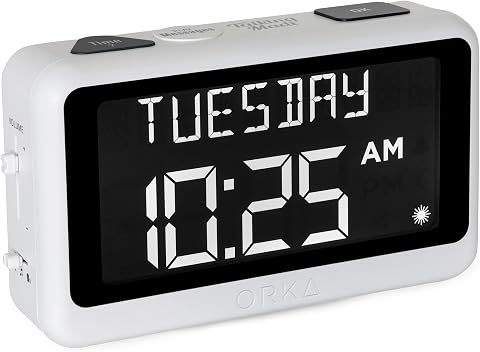
This AC-powered digital clock displays and announces the time, date, and day of the week, with large digits and spoken prompts in six languages. It supports up to eight recordable voice alarms, a 30-minute reminder loop, adjustable volume and brightness, and a backup battery to retain settings during power outages.
Pros:
- Large display and spoken time and date prompts support users with visual or memory impairments.
- Custom voice messages and up to eight alarms can provide personalized reminders.
- Offers six languages, adjustable volume, and a 30-minute reminder loop.
- Backup battery retains settings during a power outage.
Cons:
- Requires AC power for operation and is not battery powered.
- People with dementia may need help setting up the clock.
Best for: Users who benefit from clock-based visual or audio cues
Not ideal for: People who cannot see the display or hear its alerts
Bottom line: Check the reminder features and place the clock where cues will be noticed.
Prescription Bottle Opener
Opening prescription containers can be difficult for people with reduced hand strength, dexterity, or mobility. No specific opener is listed, so begin by asking the pharmacy about accessible packaging. Pharmacies may be able to discuss packaging options, but requirements and availability can vary, so confirm what is possible for the person’s prescriptions.
A common mistake is buying an opener without checking the bottle and cap styles it needs to handle. Review the current containers and consider whether the person can position and stabilize them safely. If choosing an aid, look for clear instructions and a grip or motion the user can manage. Do not transfer medication into a different container unless the pharmacist confirms it is suitable.
Think about where the opener will be used and whether the user can retrieve and store it easily. If a caregiver will open bottles, agree on a consistent routine that keeps each medication identifiable and follows label instructions. For a user with pain, weakness, or limited movement, ask an occupational therapist or clinician for practical recommendations tailored to their abilities. Reassess the solution when bottle styles or the person’s needs change.
What to look for:
- Compatibility with the person’s current bottle and cap styles
- A grip and operating motion the user can manage
- Instructions that are easy to follow
- A stable way to hold the bottle during use
- Pharmacy guidance on accessible packaging options
Set your buying order by the routine’s biggest friction point: first address dose organization or reminders, then consider storage and accessibility aids. For every item, verify fit with the person’s schedule, abilities, medication containers, and professional instructions before purchasing.
Medication routines can change, and the right setup may take a little adjustment. Keep the pharmacist and caregiver involved, make responsibilities clear, and review the arrangement whenever a prescription or daily routine changes. A simple, workable system is a good place to begin.
Halloween Picks

Vexalify 11-Inch Halloween Pumpkin Fog Machine with 12-Color Lights

Pumpkin Halloween Fog Machine with 12-Color LED Lights, Bluetooth Speaker, and Remote

Halloween Inflatable Haunted House Maze – 20×20 ft with Removable Roof and Blower
As an affiliate, we earn on qualifying purchases.