
📊 Full opportunity report: Appointment no-show recovery planner for therapy practices on IdeaNavigator AI — validation score, market gap, and execution plan.
TL;DR
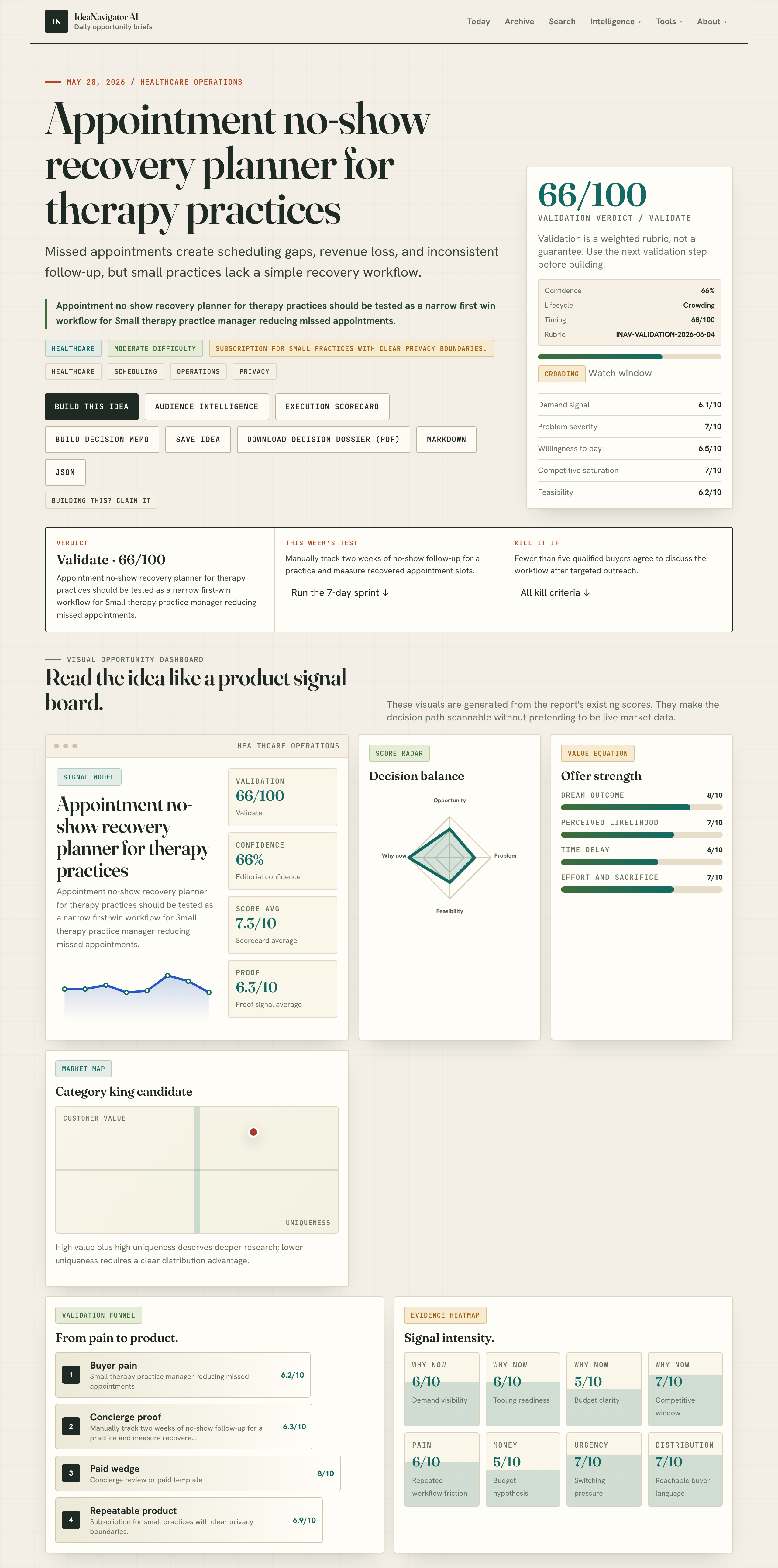
A new no-show recovery planner for small therapy practices is entering testing, aiming to reduce missed appointments through simple follow-up workflows. The tool logs missed visits, reminders, and rescheduling efforts. Validation involves measuring recovered appointment slots over two weeks.
A new appointment no-show recovery planner for small therapy practices is being tested as a targeted workflow to reduce missed appointments and improve scheduling efficiency, addressing a common operational challenge.
The initiative focuses on creating a non-clinical tool that logs missed visits, tracks reminder attempts, and facilitates rescheduling outreach. It is designed specifically for small therapy practices that lack streamlined recovery workflows. The plan involves a subscription-based model, with initial validation through manual tracking of two weeks of follow-up efforts to measure the number of recovered appointment slots. This approach aims to help practices minimize revenue loss caused by no-shows and improve patient follow-up without making clinical claims or overhauling existing systems.Potential Impact on Small Therapy Practice Operations
If successful, this no-show recovery planner could significantly improve operational efficiency for small therapy practices by reducing scheduling gaps and revenue loss. It offers a simple, privacy-conscious solution that can be quickly implemented and scaled, addressing a widespread pain point in healthcare management. The tool’s focus on operational workflows rather than clinical intervention makes it accessible and compliant with healthcare privacy standards, potentially setting a new standard for appointment follow-up procedures in small practices.therapy appointment reminder system
As an affiliate, we earn on qualifying purchases.
As an affiliate, we earn on qualifying purchases.
Current Challenges in Managing Missed Therapy Appointments
Missed appointments are a common issue in therapy practices, leading to scheduling gaps, lost revenue, and inconsistent patient follow-up. Small practices often lack dedicated workflows or tools to systematically address no-shows, relying instead on manual efforts. The need for operational tools that improve reminder effectiveness and follow-up without clinical claims has grown, especially as practices seek cost-effective solutions amid staffing and resource constraints. The proposed planner aims to fill this gap by providing a simple, trackable process that can be tested and validated within a short timeframe.“This recovery planner could streamline no-show follow-up, helping small practices regain missed appointment slots and improve revenue flow.”
— an anonymous researcher
Uncertainties Around Implementation and Effectiveness
It is not yet clear how effective the recovery planner will be across different practice sizes or patient populations. The validation process involves manual tracking, and results may vary depending on practice workflows and patient engagement levels. Further testing is needed to determine long-term impact and scalability.Next Steps in Validation and Potential Rollout
Practices participating in the initial testing will track no-show follow-up efforts over two weeks, measuring recovered appointment slots. Based on these results, developers may refine the tool and prepare for broader deployment. Additional validation studies could follow to confirm effectiveness across diverse practice settings. The goal is to establish a scalable, easy-to-adopt workflow that can be integrated into existing scheduling systems.Key Questions
How does the no-show recovery planner work?
The planner logs missed visits, tracks reminder attempts, and facilitates outreach for rescheduling, aiming to recover missed appointment slots efficiently.
Is this tool intended for large practices or only small practices?
The current focus is on small therapy practices that lack dedicated no-show workflows, though successful validation could lead to broader applicability.
Will this require significant changes to existing practice management systems?
No, the initial version is designed to be a simple, non-intrusive workflow that can be integrated easily without major system overhauls.
When will the results of the validation be available?
Results from the two-week manual tracking phase are expected shortly, which will inform further development and potential rollout plans.
Could this tool violate patient privacy or data regulations?
The planner is designed with clear privacy boundaries, focusing on operational logging without handling sensitive clinical data, aligning with healthcare privacy standards.
Source: IdeaNavigator AI

![[Korea Medical Tourism] Korea's Vision-Correction Care Draws Global Attention... "One-Stop Programs Are A Key Driver" - 헬스경향](https://caregiversupportnetwork.org/wp-content/uploads/2026/09/korea-medical-tourism-korea-s-vision-correction-care-draws-global-attention-one-featured-560x300.jpg)