
TL;DR

Turn quiet afternoons into listening time
- Thousands of audiobooks, podcasts and originals
- Listen on your phone, tablet or Echo — also offline
- Cancel anytime
A KFF Health News report describes research on firearm access among older adults with cognitive decline and the difficulty families and clinicians face discussing safety. Researchers favor early, nonjudgmental conversations and harm-reduction steps such as locking and unloading guns; the report does not describe a new law or clinical directive.
A KFF Health News report on firearm safety and cognitive decline describes research showing that older adults with worsening memory may have guns at home, sometimes stored insecurely, and that safety discussions often do not happen early. Researchers interviewed for the report recommend addressing access and storage while people can still take part in decisions, rather than treating a dementia diagnosis as an automatic reason to remove firearms.
The report recounts an interview by Laura Prater, a firearms researcher at Ohio State, with a 72-year-old retired health administrator near Seattle. A questionnaire indicated mild cognitive impairment, and his doctor had diagnosed depression. He told Prater he owned a shotgun and had recently bought a pistol. The pistol was loaded in a nightstand drawer; the shotgun was unloaded near the bed, with ammunition on the nightstand. He described the guns as protection because he lived alone. The account is one case from a study, not evidence about every older gun owner with memory problems.
Researchers cited by KFF estimate that at least one-third of people with dementia have access to firearms. A survey across seven states found that one-third of adults 65 and older who reported “subjective cognitive decline” said a gun was in their household; one-quarter of that group had not stored guns securely. The researchers cautioned that the difference in nonsecure storage compared with adults with normal cognition was not statistically significant.
CDC data cited in the report show that 8,226 Americans aged 65 and older died from firearms in 2024, an average of nearly 23 a day. More than 90% of firearm deaths in this age group were suicides, according to the report. Those figures describe deaths, not the specific share involving dementia or cognitive decline.
Early Conversations Can Reduce Risk
The concern extends beyond people with a formal dementia diagnosis. Memory problems and confusion may affect how someone handles or stores a firearm, while a gun that is readily accessible can create risks of suicide, accidental discharge, or mistaken shootings, researchers said. The report does not establish that cognitive decline alone predicts any of these outcomes; it explains why researchers consider access and storage worth discussing.
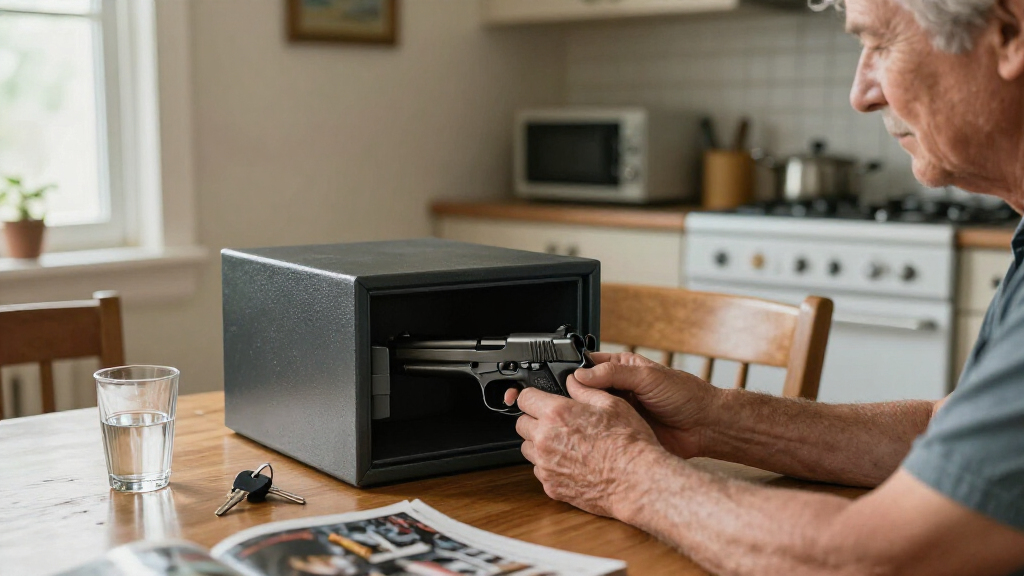
Experts favor a harm-reduction approach: talk about specific risks, encourage guns to be unloaded and locked, and offer trigger locks or lockboxes. This can address safety without demanding that an owner immediately give up a firearm. Kelsey Conrick of the University of Washington said that taking away guns may feel to an owner like losing a protector role. The approach matters because cooperation may be more feasible when people are included in decisions, especially before impairment becomes more severe.
Families and clinicians may also benefit from raising the subject before a crisis. The report cites a 2020 study in which only about 5% of caregivers for people with dementia said a health professional had discussed firearm safety with them. That finding points to a gap in conversations, not proof that every patient or caregiver needs the same intervention.
Products Worth Considering

Therabody Theragun Relief Massage Gun

Therabody Theragun Mini 3rd Generation Massage Gun, Black

BowFlex Results Series 552 SelectTech Adjustable Dumbbell
As an affiliate, we earn on qualifying purchases.
Why Firearm Discussions Can Stall
For some older adults, firearms are tied to identity, independence, and a sense of protection. Marian Betz, an emergency physician and firearm-injury prevention researcher at the University of Colorado Anschutz, told KFF that aging can bring a heightened sense of vulnerability. She also cautioned that statistics may not change decisions driven by fear. The report notes a 2011 meta-analysis often cited in this debate, which found increased risks of suicide and accidents in homes with firearms and no credible evidence that a household gun deterred crime or reduced injuries during intrusions or altercations.
Families may hesitate to raise storage or removal because they fear conflict with an older relative they will continue to support. A study of 50 dementia caregivers found that many had witnessed reckless behavior or near misses but worried that confrontation could damage the relationship. Researchers also say some patients may avoid telling doctors about gun ownership because they mistakenly believe disclosure of depression or dementia will automatically lead to confiscation. The report says those diagnoses alone do not require medical personnel to take that action.
Legal tools vary by location. According to the report, 22 states and Washington, D.C., had extreme risk protection order laws that can temporarily restrict firearm access. The existence of such laws does not mean a clinician can or will use them in a particular case; applicable rules and procedures depend on jurisdiction.
“It was alarming, but not uncommon.”
— Laura Prater, firearms researcher at Ohio State
What the Research Cannot Yet Show
The supplied report does not give a publication date for the cited seven-state survey or provide its sample size, so readers cannot assess those details from the material here. Its finding that one-quarter of respondents with subjective cognitive decline had not securely stored firearms is a survey result; it does not establish that cognitive decline caused unsafe storage. The report also says the storage difference from adults with normal cognition was not statistically significant.
It remains unclear how often firearm-related injuries or deaths among older adults involve cognitive impairment, and how well particular interventions work across different households. The report gives no single recommended legal or clinical response for every situation. Decisions may depend on the person’s condition, immediate circumstances, family support, and local law.
Building Safety Into Care Conversations
The report describes researchers’ effort to focus on older adults with early or self-reported cognitive changes, before a formal dementia diagnosis or more serious impairment. The next practical step discussed by experts is a respectful conversation about whether firearms are present and how they are stored, with options such as unloading, locking, and providing storage devices. The source does not announce a new program, policy, or study milestone.
Families concerned about a relative can raise the issue with a qualified health professional and discuss locally available support and laws. For an immediate risk of harm or a mental health crisis in the United States, call or text 988 for the Suicide & Crisis Lifeline; use emergency services if there is imminent danger.
Key Questions
Does an early sign of dementia automatically mean a person must give up their guns?
No. The report says depression or dementia diagnoses alone do not require medical personnel to confiscate firearms. The appropriate response depends on circumstances and local law; the experts cited favor discussing risks and safer storage rather than assuming removal is the only option.
What safer storage steps do the researchers recommend?
The harm-reduction approach described in the report includes keeping firearms unloaded and locked and using devices such as trigger locks or lockboxes. The report does not set out a one-size-fits-all storage plan.
How common is firearm access among older adults with memory concerns?
In a survey across seven states cited by KFF, one-third of adults aged 65 and older who reported subjective cognitive decline said there was a gun in their household. One-quarter of that group had not stored guns securely. The report says the comparison in nonsecure storage with people with normal cognition was not statistically significant.
Can a doctor report a patient’s firearm ownership and have the guns removed?
The report says a diagnosis of depression or dementia by itself does not require medical personnel to take that action. It notes that extreme risk protection order laws, which can temporarily restrict firearm access, existed in 22 states and Washington, D.C., at the time described. Rules and procedures vary by location.
Source: kffhealthnews.org