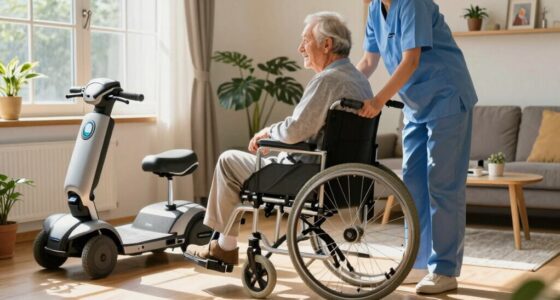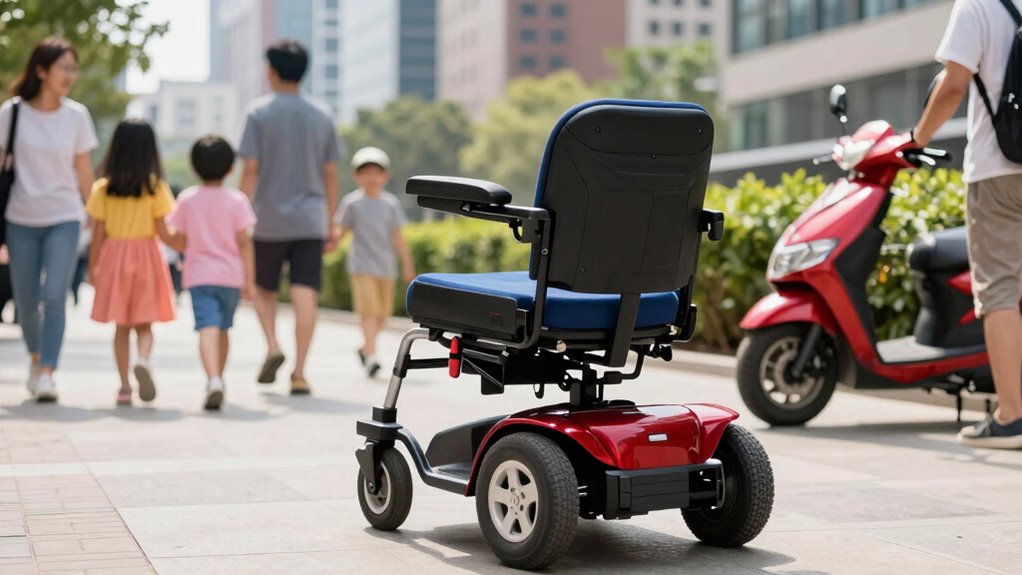

When choosing between a power wheelchair and a scooter, consider your loved one’s medical needs, mobility level, and lifestyle. Power wheelchairs provide better support, stability, and customization for those with muscle weakness or balance issues, promoting safety and independence. Scooters are more affordable, easier to transport, and suitable for short outings. To make the best choice, it’s important to evaluate long-term health benefits and costs—learning more can help you find the perfect solution.

Turn quiet afternoons into listening time
- Thousands of audiobooks, podcasts and originals
- Listen on your phone, tablet or Echo — also offline
- Cancel anytime
Key Takeaways
- Evaluate medical needs such as posture support, stability, and pressure relief to determine if a power wheelchair is necessary.
- Consider mobility scope: power wheelchairs offer greater indoor stability, while scooters excel for outdoor, short-distance travel.
- Assess financial factors: initial costs, maintenance expenses, and potential long-term healthcare savings.
- Consult healthcare professionals to tailor device features like seating, tilt, and support for individual health conditions.
- Choose based on long-term independence, safety, and comfort rather than immediate affordability alone.
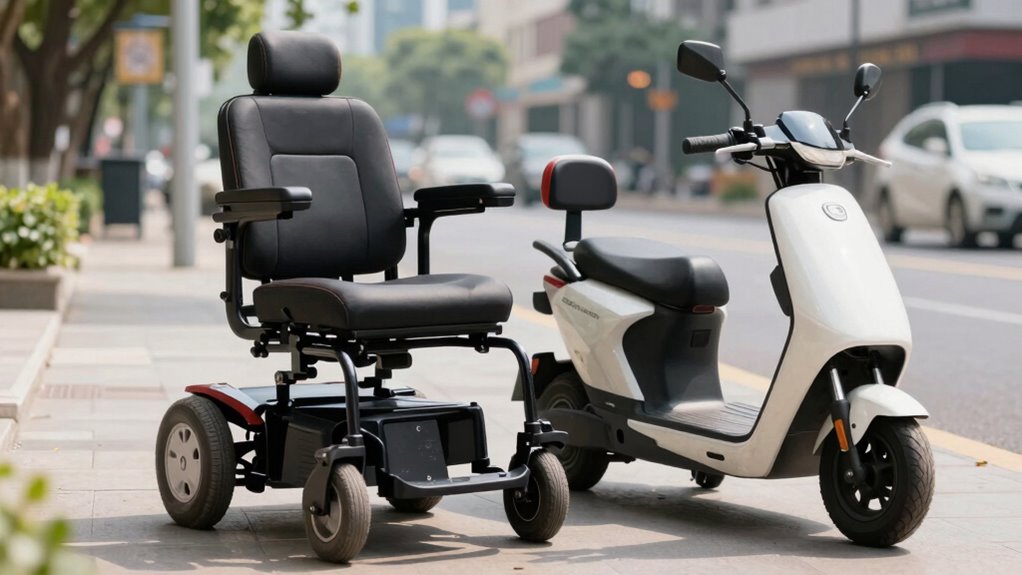
Are you unsure whether a power wheelchair or a scooter best suits your mobility needs? Making the right choice can significantly impact your daily life, so it’s essential to consider both medical benefits and cost considerations. Power wheelchairs provide excellent support for individuals needing more stability and assistance with posture. They often come equipped with features that help reduce pressure sores, improve circulation, and accommodate medical devices like ventilators or specialized seating. If your mobility challenges are linked to muscle weakness, balance issues, or limited endurance, a power wheelchair can offer the medical benefits of enhanced support and safety. This can lead to less fatigue and a decreased risk of falls, which is crucial for maintaining your health and independence.
On the other hand, scooters are generally more affordable and easier to transport, making them appealing for those who need simple mobility solutions for short distances. When evaluating cost considerations, scooters tend to have a lower initial purchase price and usually require less maintenance over time. They are lighter, more compact, and can often be disassembled into smaller parts, allowing for easier storage and transport in vehicles. If your primary goal is to navigate around your home, run errands, or enjoy outdoor activities without the need for extensive medical support, a scooter might be the more economical and practical choice. Additionally, understanding the biodiversity in mobility devices ensures that users can find solutions tailored to their unique health requirements.
However, it’s important to remember that medical benefits extend beyond just comfort and stability. If you have specific health conditions, such as spinal cord injuries, muscular dystrophy, or arthritis, the medical benefits of a power wheelchair could outweigh the initial savings of a scooter. Power wheelchairs can be customized with features like adjustable seat height, tilt, recline, and lateral supports, which can help prevent pressure ulcers and improve overall health. These modifications can promote better posture and reduce discomfort during prolonged use, ultimately supporting your medical needs more effectively. Additionally, mobility device customization allows for tailored solutions that enhance user comfort and health outcomes. Furthermore, choosing the right device can impact long-term costs, especially if it helps prevent medical complications that would require additional treatment.
Cost considerations also include long-term expenses. While a power wheelchair may cost more upfront, it might reduce your healthcare costs over time by preventing injuries or medical complications related to inadequate support. Conversely, scooters might be cheaper initially but could lead to higher costs if they don’t provide the necessary medical benefits or comfort, prompting more frequent replacements or repairs.
Ultimately, the decision hinges on your specific health conditions, mobility requirements, and financial situation. Carefully weigh the medical benefits against the cost considerations, and consult with healthcare professionals to determine which mobility device will best support your independence and well-being.
power wheelchair with adjustable tilt and recline
As an affiliate, we earn on qualifying purchases.
As an affiliate, we earn on qualifying purchases.
Frequently Asked Questions
How Do Maintenance Costs Compare Between Wheelchairs and Scooters?
You’ll find that maintenance costs for wheelchairs and scooters are quite similar, but scooters often have lower repair expenses due to simpler designs. Battery longevity plays a vital role; scooters generally have batteries that last longer, reducing replacement frequency. Regular upkeep, like checking tires and batteries, helps keep costs predictable. Overall, scooters tend to be more budget-friendly over time, but it’s important to take into account individual usage and manufacturer recommendations.
Are There Specific Insurance Coverages for Power Wheelchairs Versus Scooters?
Yes, there are specific insurance coverages for power wheelchairs versus scooters. You should check your insurance’s eligibility criteria, as coverage differences often depend on the device’s classification and your medical needs. Power wheelchairs typically qualify for more extensive coverage due to their complexity, while scooters might have more limited coverage. Always verify with your insurer to understand what’s included and guarantee you meet the necessary requirements.
Can a Power Wheelchair or Scooter Be Easily Transported in a Vehicle?
Yes, you can transport a power wheelchair or scooter in a vehicle, but vehicle compatibility matters. Check if your vehicle has enough space and the right features, like a lift or ramp. Storage solutions, such as foldable models or secure straps, make it easier to load and unload. Always consider the size and weight of the mobility device to guarantee safe, convenient transportation.
What Safety Features Are Standard on Each Mobility Device?
Safety features are the backbone of each mobility device. You’ll find standard features like anti-tip wheels, seat belts, and reliable braking systems on both. Power wheelchairs often include pressure relief seating for comfort, while scooters focus on stable steering and anti-slip decks. Battery longevity is essential, ensuring your device stays powered longer, and seating comfort keeps you secure and comfortable. Always check these features to keep safety top of mind.
How Do Outdoor Terrain Capabilities Differ Between Wheelchairs and Scooters?
You’ll find that wheelchairs generally excel in terrain navigation and obstacle clearance, especially with features like larger wheels and better suspension. Scooters often perform well on smooth outdoor surfaces but can struggle with rough terrain or uneven ground. If outdoor adventures are frequent, a power wheelchair with enhanced obstacle clearance and better suspension might be the smarter choice. Consider your typical terrain to guarantee safe, confident mobility outside.
Conclusion
Just like choosing between a ship and a sailboat, picking a power wheelchair or scooter depends on your unique voyage. Think of the decision as your personal quest for independence—each option offers its own adventure. So, ask yourself what fits your lifestyle best. Remember, as the wise say, “The journey of a thousand miles begins with a single step.” Whichever you choose, it’s your journey—make it a good one.
Columbus Day / Indigenous Peoples' Day Picks
long weekend sales
As an affiliate, we earn on qualifying purchases.