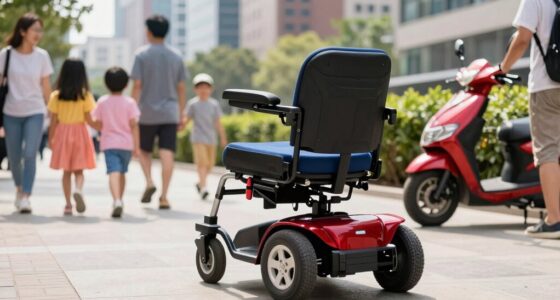

Your focus should be on a small indoor turning radius rather than top speed, because it directly affects safety, efficiency, and space use in tight areas. A tight turning radius lets your robot maneuver smoothly, avoid collisions, and reduce damage risks. It also allows for better navigation in narrow aisles, maximizing storage and workspace. Prioritizing turnability ensures safer, more reliable operations without sacrificing speed. Keep exploring how these factors work together for ideal indoor mobility.

Turn quiet afternoons into listening time
- Thousands of audiobooks, podcasts and originals
- Listen on your phone, tablet or Echo — also offline
- Cancel anytime
Key Takeaways
- A small turning radius enhances safety by allowing precise navigation in tight indoor spaces, reducing collision risks.
- It improves operational efficiency by enabling quick, smooth direction changes without delays.
- Compact turning capabilities optimize space utilization, fitting more equipment and shelves in confined environments.
- Reduced turning radius minimizes mechanical strain and damage, extending equipment lifespan and lowering maintenance costs.
- It supports flexible layout design and better navigation paths, ensuring safer, more adaptable indoor operations.

When maneuvering indoor spaces, understanding the importance of turning radius can make a significant difference in safety and efficiency. It’s easy to assume that top speed matters most, but in tight environments like warehouses or factories, the turning radius often has a bigger impact on operations. The space you have to turn around directly affects how smoothly your robots or vehicles operate, influencing both robot safety and overall warehouse efficiency. If a robot needs to take wide turns, it takes up more space, causes delays, and increases the risk of collisions with shelves, workers, or other machines.
Having a small indoor turning radius allows your robots to navigate narrow aisles and tight corners more comfortably. This agility means less need for complex maneuvers or manual intervention, which improves robot safety by reducing the chances of accidents. When robots can turn efficiently in confined spaces, they’re less likely to bump into obstacles or cause damage, keeping both your equipment and personnel safer. Additionally, a smaller turning radius minimizes the risk of tipping or losing control during sharp turns, further enhancing safety protocols.
A small turning radius enhances safety by enabling smoother, more controlled navigation in tight spaces.
From a warehouse efficiency standpoint, a tight turning radius accelerates workflow. Robots can quickly change direction and continue their tasks without unnecessary detours or waiting for the space to clear. This agility optimizes throughput, enabling more deliveries, pickups, and inventory movements within the same timeframe. The ability to operate smoothly in confined spaces also means you can maximize storage density — fitting more shelves and equipment into the same footprint without sacrificing accessibility or safety. Moreover, a well-designed turning radius can prevent additional strain on machinery, reducing maintenance costs and extending equipment lifespan. Properly managing turning radius design can also improve the overall layout planning, making the space more adaptable to changing operational needs. Incorporating cross-corner maneuverability considerations into your design can significantly enhance space utilization and operational flexibility. Additionally, optimizing for a smaller turning radius can also help in maintaining consistent robot navigation paths, which further streamlines operations. Recognizing the importance of maneuverability in confined environments can lead to more efficient and safer robotic systems.
As an affiliate, we earn on qualifying purchases.
Frequently Asked Questions
How Is Indoor Turning Radius Measured?
You measure indoor turning radius using specific measurement techniques, typically involving a tape measure or laser distance meter to track the smallest turning circle of your vehicle. Calibration methods guarantee accuracy by adjusting for factors like wheel alignment and sensor precision. To get precise results, you should perform multiple tests, record the tightest turning points, and calibrate your equipment regularly, ensuring reliable measurements for maneuverability assessments.
Does Turning Radius Affect Vehicle Safety Indoors?
Yes, your vehicle’s turning radius considerably affects safety indoors. A tight turning radius allows you to maneuver easily around obstacles and tight corners, reducing the risk of collisions. While exterior design influences aesthetics, a smaller radius improves off-road capability and agility in confined spaces. With better control and maneuverability, you can navigate indoor environments more confidently, minimizing accidents and ensuring safer operation in tight, complex spaces.
Can a Small Turning Radius Improve Energy Efficiency?
Yes, a small turning radius can improve energy efficiency. By enhancing maneuverability efficiency, it allows you to make tighter turns with less effort and energy expenditure. This reduces the need for unnecessary acceleration or braking, conserving energy overall. Especially indoors, where space is limited, a compact turning radius means you can navigate more smoothly and with less power, ultimately helping you save energy and extend your vehicle’s operational range.
How Does Turning Radius Influence Warehouse Layout?
Your warehouse layout is heavily influenced by the turning radius, as it determines how easily vehicles navigate tight spaces. A smaller turning radius enhances outdoor maneuverability and vehicle agility, allowing forklifts and carts to turn sharper corners without hassle. This flexibility means you can optimize aisle widths, storage placement, and overall flow, leading to increased efficiency, reduced congestion, and safer operations within confined spaces.
Is Turning Radius More Important Than Acceleration?
Turning radius is more important than acceleration because it impacts maneuverability and safety indoors. You need good vehicle aerodynamics and tire grip to execute tight turns efficiently, especially in confined spaces. While acceleration helps reach speeds quickly, a tight turning radius allows you to navigate complex layouts without accidents. Prioritizing turning radius guarantees smoother, safer operations, making your vehicle more adaptable to indoor environments where agility matters most.
Conclusion
Think of a vehicle’s turning radius as its heartbeat—guiding every move within tight spaces. When you prioritize this, you’re equipping yourself with agility and grace, maneuvering corners like a dancer on a stage. Top speed may thrill, but the true mastery lies in your ability to turn, adapt, and flow seamlessly. Remember, in the dance of indoors, it’s the radius that keeps your rhythm steady, your journey smooth, and your confidence unwavering.
Halloween Picks
halloween
As an affiliate, we earn on qualifying purchases.